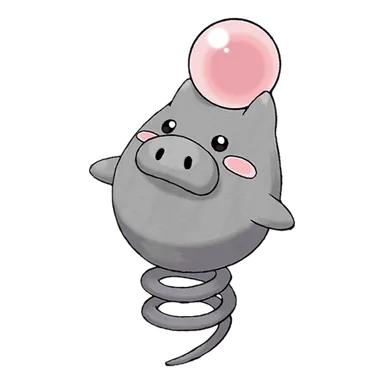
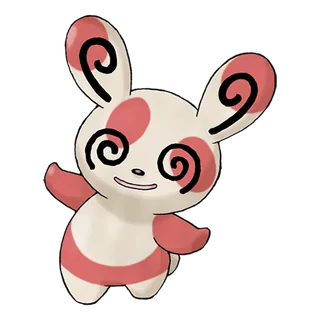
Spinda is a Normal-type Pokémon introduced in Generation III, with a base stat total of 360 and no standard evolutions.
Spinda

Abilities
Prevents confusion.
Raises evasion if the Pokémon is confused.
Makes stat changes have an opposite effect.
Hidden AbilityBase Stats
Spinda's Weaknesses and Resistances


Evolution Chain
Spinda does not evolve into or from any other Pokémon.
 Spinda
 Playthrough, Competitive, and Nuzlocke Usage
Using Spinda in a Playthrough
Spinda is a single-stage pure Normal-type with base 60 in every stat, giving it no major statistical strength and leaving it noticeably weaker than most fully evolved Pokemon. Pure Normal typing at least provides a Ghost immunity and only one Fighting weakness, while its movepool is far broader than the stat line suggests and can include Body Slam, Fake Out, Sucker Punch, elemental coverage, Teeter Dance, Wish, Baton Pass, Trick, and other unusual tools depending on generation. Own Tempo prevents confusion, Tangled Feet can raise evasion while confused, and Contrary reverses stat changes, creating the line's most interesting offensive trick by turning Superpower's normal Attack and Defense drops into repeated boosts. Even with that synergy, base 60 Attack and Speed make Spinda slow to build momentum and too fragile to assume it will survive several setup turns. For a normal playthrough it is best treated as a quirky utility Pokemon whose broad movepool and ability interactions are more interesting than its actual efficiency.
Spinda in Competitive Pokémon
Spinda has essentially never been competitively viable in standard singles because six base-60 stats leave it too weak, too slow, and too frail to perform any ordinary offensive or defensive role well. Its most recognizable niche is Contrary Superpower: instead of lowering Attack and Defense after each use, Superpower raises both stats, theoretically allowing Spinda to become progressively stronger and harder to remove. The concept is clever but the execution is poor because the first attack still begins from base 60 Attack, faster opponents can overwhelm Spinda before enough boosts accumulate, and stronger Contrary users or ordinary setup sweepers perform similar jobs much more effectively. Wish, Trick, Baton Pass, Fake Out, Teeter Dance, and broad coverage give it novelty options, but competitive analyses consistently describe those tools as insufficient to overcome the raw statistical deficit. Spinda is therefore a good example of a Pokemon with fascinating mechanics but no meaningful high-level metagame role.
Spinda in Nuzlockes
Spinda is a risky Nuzlocke encounter because its evenly distributed base-60 stats provide no strong defensive or offensive fallback when a battle becomes unfavorable. Own Tempo can remove confusion as a threat entirely, while Contrary can punish opponents that rely on stat-lowering moves and can make Superpower improve Attack and Defense rather than reduce them. Teeter Dance, Wish, Fake Out, or other utility can create situational safety, but relying on confusion or repeated setup is less dependable in permadeath play than simply using a Pokemon with stronger natural stats. Pure Normal typing is at least straightforward, providing a Ghost immunity and only a Fighting weakness, yet powerful neutral attacks remain dangerous because Spinda's defenses are only average. It can succeed in carefully chosen matchups, but most Nuzlocke teams should view Spinda as a specialist or challenge pick rather than a naturally safe core member.
Learnsets
13 moves · Brilliant Diamond Shining Pearl
Level Up — Brilliant Diamond Shining Pearl





Pokédex Entries
14 entries
No two Spinda have the same pattern of spots. Its tottering step fouls the aim of foes.
All the SPINDA that exist in the world are said to have utterly unique spot patterns. The shaky, tottering steps of this POKéMON give it the appearance of dancing.
No two SPINDA are said to have identical spot patterns on their hides. This POKéMON moves in a curious manner as if it is stumbling in dizziness. Its lurching movements can cause the opponent to become confused.
It is distinguished by a pattern of spots that is always different. Its unsteady, tottering walk has the effect of fouling its foe’s aim.
No two SPINDA are said to have identical patterns. It confuses foes with its stumbling motions.
No two SPINDA have the same pattern of spots. Its tottering step fouls the aim of foes.
The chances of two SPINDA having identical spot patterns is less than one in four billion.
The chances of two Spinda having identical spot patterns is less than one in four billion.
All the Spinda that exist in the world are said to have utterly unique spot patterns. The shaky, tottering steps of this Pokémon give it the appearance of dancing.
No two Spinda are said to have identical spot patterns on their hides. This Pokémon moves in a curious manner as if it is stumbling in dizziness. Its lurching movements can cause the opponent to become confused.
Its steps are staggering and unsteady, but Spinda thinks it’s walking in a straight line.
Each and every Spinda has a slightly different configuration of spots. There are collectors who enjoy the tiny differences in their spot patterns.
Its steps are shaky and stumbling. Walking for a long time makes it feel sick.
Each Spinda’s spot pattern is different. With its stumbling movements, it evades opponents’ attacks brilliantly!
Where To Find Spinda
7 locations
Ten Carat Hill · AlolaWalking · version details vary
Ten Carat Hill Farthest Hollow
Route 113 · HoennHorde, Walking · version details vary
Road 113
Bell Tower · JohtoWalking · version details vary
Bell Tower (10F)
Bell Tower (2F)
Bell Tower (3F)
Bell Tower (4F)
Bell Tower (5F)
Bell Tower (6F)
Bell Tower (7F)
Bell Tower (8F)
Bell Tower (9F)
Burned Tower · JohtoWalking · version details vary
Burned Tower (1F)
Burned Tower (B1F)
Sprout Tower · JohtoWalking · version details vary
Sprout Tower (2F)
Sprout Tower (3F)
Route 21 · KalosHorde, Purple Flowers, Red Flowers · version details vary
Road 21
Route 227 · SinnohWalking · version details vary
Road 227
Held Items
1 items
- Ruby: 5% chance
- Sapphire: 5% chance
- Emerald: 5% chance
- Firered: 5% chance
- Leafgreen: 5% chance
- Diamond: 5% chance
- Pearl: 5% chance
- Platinum: 5% chance
- Heartgold: 5% chance
- Soulsilver: 5% chance
- Black: 5% chance
- White: 5% chance
- Black 2: 5% chance
- White 2: 5% chance
Additional Images
PokeAPI sprites
Open this section to load extra PokeAPI sprite images.
Spinda Biology and Behavior
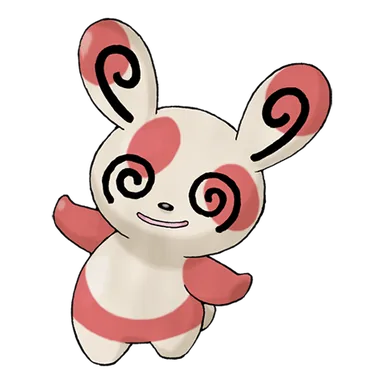
Every Spinda carries a different arrangement of red spots across its face and head, with Pokedex accounts describing the chance of two individuals sharing the same pattern as less than one in four billion. The apparent drunkenness of its movement is equally distinctive: Spinda believes it is walking in a straight line even while its body sways, staggers, and loops unpredictably from side to side. Those erratic motions are not merely clumsy, because opponents have difficulty aiming at a target whose path is so difficult to predict and may become confused simply from watching it. Spinda lives in mountainous regions and historically had such a strong association with dizzying movement that Teeter Dance was originally treated as its signature technique. Individual appearance and movement therefore combine to make each Spinda unusually difficult to predict both visually and behaviorally.
Spinda Biological Data
- National Pokédex
- #327
- Species
- Spot Panda Pokémon
- Height
- 3' 7" (1.1 m)
- Weight
- 11.0 lbs (5.0 kg)
- Habitat
- Mountain
- Color
- Brown
- Body Style
- Upright
- Gender
- 50% female / 50% male
Misc
Catch Rate: 255
Base Experience: 126 Exp
Hatch Counter: 15
Spinda Size Comparison: BETA
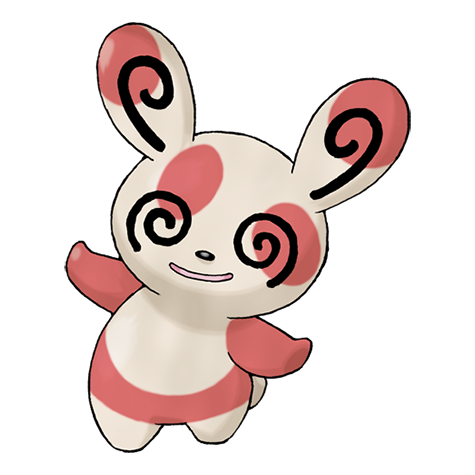
Spinda is listed at 3' 7" (1.1 m) and shown in an in-chart visual comparison.

How is visual size determined?
Pokédex height is treated as the official listed measurement, but the chart uses pose-aware visual scaling so each sprite looks reasonable in a direct comparison.
For long or coiled Pokémon, the listed height may represent total body length rather than upright height. For Pokémon with floppy ears, leaves, feathers, antennae, wings, or other flexible features, the chart usually measures to the top of the solid, substantial part of the head or body instead of the tallest decorative feature.
The goal is not to replace the official height, but to make the artwork compare naturally at the size it appears to occupy.