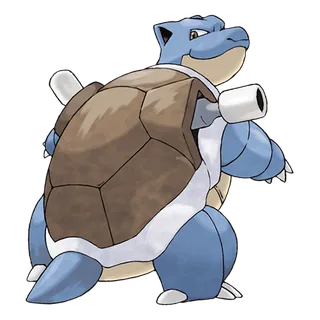
Blastoise is a Water-type Pokémon introduced in Generation I and a final stage of its evolution line, with a base stat total of 530.
Blastoise

Abilities
Base Stats
Blastoise's Weaknesses and Resistances



Evolution Chain
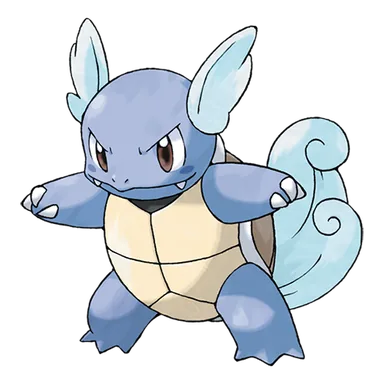
Squirtle evolves into Wartortle at level 16, and Wartortle evolves into Blastoise at level 36.
 Squirtle
 Wartortle
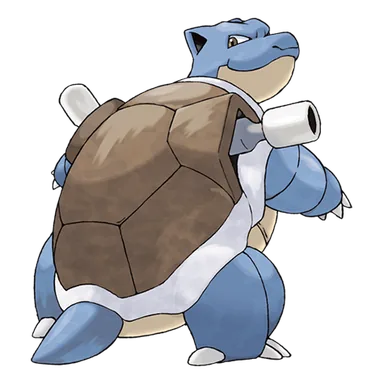 Blastoise
Forms
 Mega Blastoise
 Blastoise Gmax
Blastoise Playthrough, Competitive, and Nuzlocke Usage
Using Blastoise in a Playthrough
The Squirtle line provides one of the most consistent starter experiences, combining good defenses with reliable Water STAB and relatively few exploitable weaknesses. Squirtle performs well against Brock in Kanto and remains dependable throughout the game rather than being heavily concentrated around particular matchups, while Blastoise's 100 Defense and 105 Special Defense allow it to survive attacks that would threaten more offensive starters. Surf provides powerful and reliable Water STAB in generations where it is available, and Ice coverage gives Blastoise valuable answers to several types, particularly late-game Dragons. Its main disadvantage is replaceability rather than weakness: Pokemon games frequently provide numerous excellent Water-types with stronger offenses, secondary typings, or additional utility.
Blastoise in Competitive Pokémon
Blastoise has historically used its balanced defenses and Water typing in defensive, utility, and offensive roles, with Rapid Spin giving it particular value as an entry-hazard remover in several generations. The addition of Shell Smash dramatically expanded its offensive potential by boosting both attacking stats and Speed, allowing modern Blastoise to function as a setup sweeper using Water STAB alongside broad special coverage. Mega Blastoise further emphasizes offense through increased Special Attack, improved defenses, and Mega Launcher-boosted pulse moves, allowing it to operate as a bulky wallbreaker or offensive spinner. Despite this flexibility, base Blastoise often faces substantial competition from other Water-types, and defensive sets can be limited by its lack of dependable recovery.
Blastoise in Nuzlockes
The Squirtle line is a reliable Nuzlocke choice because Water is defensively stable, Blastoise has strong physical and special bulk, and its weaknesses are limited primarily to Grass and Electric attacks. Squirtle provides immediate value against Brock in Kanto, while Blastoise remains useful throughout a run through dependable Water STAB and Ice coverage that can become especially valuable against late-game Dragon-types. Its bulk makes failed damage calculations and unexpected neutral attacks less likely to result in immediate death, giving Blastoise a larger margin for error than many offensive Pokemon. The principal drawback is opportunity cost, since Water-types are exceptionally common in many games and other strong Water encounters are often available.
Learnsets
77 moves · Scarlet Violet
Level Up





Machine





Egg
Pokédex Entries
14 entries
A brutal POKéMON with pressurized water jets on its shell. They are used for high speed tackles.
Once it takes aim at its enemy, it blasts out water with even more force than a fire hose.
It deliberately makes itself heavy so it can withstand the recoil of the water jets it fires.
The rocket cannons on its shell fire jets of water capable of punching holes through thick steel.
It firmly plants its feet on the ground before shooting water from the jets on its back.
BLASTOISE has water spouts that protrude from its shell. The water spouts are very accurate. They can shoot bullets of water with enough accuracy to strike empty cans from a distance of over 160 feet.
The waterspouts that protrude from its shell are highly accurate. Their bullets of water can precisely nail tin cans from a distance of over 160 feet.
It crushes its foe under its heavy body to cause fainting. In a pinch, it will withdraw inside its shell.
The pressurized water jets on this brutal POKéMON’s shell are used for high- speed tackles.
The jets of water it spouts from the rocket cannons on its shell can punch through thick steel.
It deliberately makes itself heavy so it can withstand the recoil of the water jets it fires.
The rocket cannons on its shell fire jets of water capable of punching holes through thick steel.
The pressurized water jets on this brutal Pokémon’s shell are used for high-speed tackles.
Blastoise has water spouts that protrude from its shell. The water spouts are very accurate. They can shoot bullets of water with enough accuracy to strike empty cans from a distance of over 160 feet.
Additional Images
PokeAPI sprites
Open this section to load extra PokeAPI sprite images.
Blastoise Biology and Behavior
Blastoise's shell contains retractable high-pressure water cannons capable of piercing steel and concrete, and it deliberately increases its stability and apparent weight to withstand their recoil. The same water jets can propel Blastoise forward with tremendous force or even launch it into the air, giving what appears to be a heavily armored animal surprising mobility. In the animated series, Blastoise has been shown acting as the leader of colonies containing Squirtle and Wartortle, suggesting a social hierarchy within wild groups of the evolutionary line. It normally protects itself while sleeping inside its shell, although a Blastoise that feels completely secure may occasionally sleep with its vulnerable underside exposed.
Blastoise Biological Data
- National Pokédex
- #9
- Species
- Shellfish Pokémon
- Height
- 5' 3" (1.6 m)
- Weight
- 188.5 lbs (85.5 kg)
- Habitat
- Waters Edge
- Color
- Blue
- Body Style
- Upright
- Gender
- 12.5% female / 87.5% male
Misc
Catch Rate: 45
Base Experience: 239 Exp
Hatch Counter: 20
Blastoise Size Comparison: BETA
Blastoise is listed at 5' 3" (1.6 m) and shown in an in-chart visual comparison.
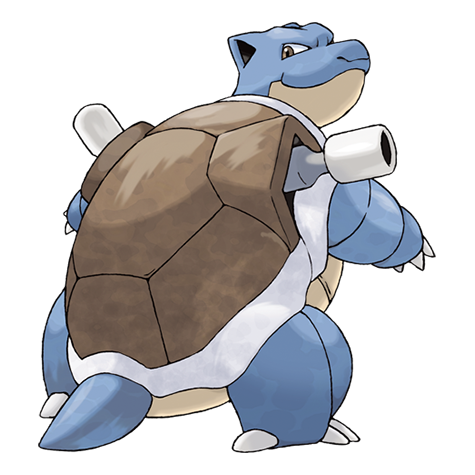

How is visual size determined?
Pokédex height is treated as the official listed measurement, but the chart uses pose-aware visual scaling so each sprite looks reasonable in a direct comparison.
For long or coiled Pokémon, the listed height may represent total body length rather than upright height. For Pokémon with floppy ears, leaves, feathers, antennae, wings, or other flexible features, the chart usually measures to the top of the solid, substantial part of the head or body instead of the tallest decorative feature.
The goal is not to replace the official height, but to make the artwork compare naturally at the size it appears to occupy.