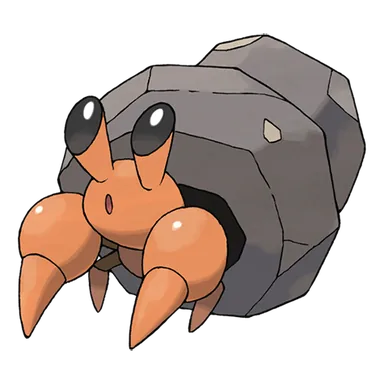
Crustle is a Bug/Rock-type Pokémon introduced in Generation V and a final stage of its evolution line, with a base stat total of 485.
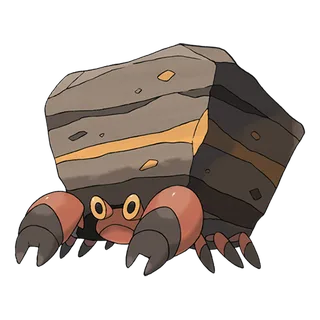
Crustle


Abilities
Negates 1-hit KO attacks.
Blocks critical hits.
Physical attacks lower Defense and raise Speed.
Hidden AbilityBase Stats
Crustle's Weaknesses and Resistances




Evolution Chain
Dwebble evolves into Crustle at level 34.
 Dwebble
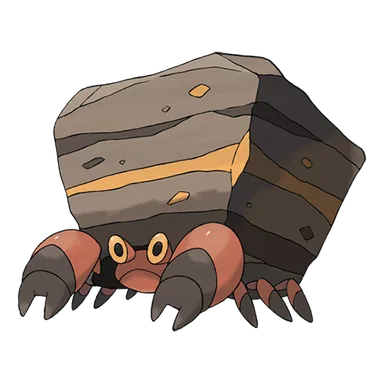 Crustle
 Playthrough, Competitive, and Nuzlocke Usage
Using Crustle in a Playthrough
Dwebble evolves into Crustle at level 34, producing a Bug/Rock Pokemon with excellent base 125 Defense and, from Generation VI onward, base 105 Attack; in Generation V its Attack was 95. Rock Slide or Stone Edge and X-Scissor provide straightforward physical STAB, while Earthquake, Rock Blast, Stealth Rock, Spikes, and Shell Smash let Crustle function as either a utility lead or a setup attacker. Sturdy guarantees survival from full HP against one otherwise lethal hit in modern mechanics, Shell Armor prevents critical hits entirely, and Weak Armor can trade Defense for Speed when struck physically. Shell Smash is the defining offensive option because it sharply raises Attack, Special Attack, and Speed at the cost of both defenses, but base 45 Speed means Crustle still benefits from careful matchup planning even after boosting. Water, Rock, and Steel attacks are super effective, and Bug/Rock provides surprisingly few useful resistances for such a physically bulky Pokemon. Adamant is the most natural offensive nature, while Impish can reinforce a hazard-setting or Shell Armor role.
Crustle in Competitive Pokémon
Crustle was a legitimate BW RU Pokemon whose best role was not conventional walling but hyper-offense support. Sturdy combined with both Stealth Rock and Spikes let it establish hazards reliably, while Shell Smash gave it the unusual ability to punish passive leads and potentially sweep rather than simply accept being sacrificed after setting hazards. Smogon specifically highlights the flexibility of Shell Smash lead sets, with Rock Blast, Earthquake, and X-Scissor allowing Crustle to pressure opposing leads after boosting. Later generations raised its Attack from 95 to 105 and changed Weak Armor so physical hits could provide even larger Speed boosts, but Crustle remained a lower-tier specialist because base 45 Speed, limited resistances, and a weakness to Stealth Rock made it high-maintenance. In SM ZU it still retained two coherent roles—Shell Smash sweeper and suicide hazard lead—showing that its competitive identity remained stable even as overall power creep increased.
Crustle in Nuzlockes
Crustle has two unusually Nuzlocke-friendly abilities. Sturdy can guarantee survival from full HP against a single otherwise lethal hit, while Shell Armor removes critical hits entirely and therefore makes physical damage far more predictable. The tradeoff is that Sturdy disappears as soon as chip damage breaks full health, and Shell Smash deliberately lowers both defenses, so the strongest competitive strategy is not always the safest permadeath strategy. Base 125 Defense allows Crustle to take many neutral physical hits, but Water, Rock, and Steel attacks are dangerous and its Special Defense is only average. Rock Slide is safer than Stone Edge when the extra power is unnecessary, while accurate X-Scissor and Earthquake reduce avoidable failure states. For a Nuzlocke, a Shell Armor or carefully maintained Sturdy Crustle used as a physical tank and hazard setter is usually safer than repeatedly trying to sweep with Shell Smash.
Learnsets
14 moves · Sword Shield
Level Up — Sword Shield



Pokédex Entries
5 entries
Competing for territory, Crustle fight viciously. The one whose boulder is broken is the loser of the battle.
It possesses legs of enormous strength, enabling it to carry heavy slabs for many days, even when crossing arid land.
When its boulder is broken in battles for territory, it feels unsure and begins to weaken.
This highly territorial Pokémon prefers dry climates. It won’t come out of its boulder on rainy days.
Its thick claws are its greatest weapons. They’re mighty enough to crack Rhyperior’s carapace.
Where To Find Crustle
4 locations
Ultra Space Wilds · AlolaOne-time · version details vary
Ultra Space Wilds Cave
Mirage Mountain · HoennRock Smash · version details vary
Mirage Mountain (South East of Route 129)
Route 18 · UnovaDark Grass, Walking · version details vary
Road 18
Seaside Cave · UnovaOne-time · version details vary
Seaside Cave (1F)
Held Items
2 items
- Black: 5% chance
- White: 5% chance
- Black 2: 5% chance
- White 2: 5% chance
- X: 5% chance
- Y: 5% chance
- Omega Ruby: 5% chance
- Alpha Sapphire: 5% chance
- Sun: 5% chance
- Moon: 5% chance
- Ultra Sun: 5% chance
- Ultra Moon: 5% chance
- Black: 1% chance
- White: 1% chance
- Black 2: 1% chance
- White 2: 1% chance
Additional Images
PokeAPI sprites
Open this section to load extra PokeAPI sprite images.
Crustle Biology and Behavior
Crustle carries an enormous layered rock as a shell and has legs strong enough to haul that weight across dry terrain for long periods. Members of the species fight fiercely over territory, and a Crustle whose shell breaks during such a battle is considered defeated and may become weak and uncertain afterward. Its claws are powerful enough to break the armored carapace of a Rhyperior. Crustle dislikes rain and may refuse to emerge from its shell on rainy days.
Crustle Biological Data
- National Pokédex
- #558
- Species
- Stone Home Pokémon
- Height
- 4' 7" (1.4 m)
- Weight
- 440.9 lbs (200.0 kg)
- Habitat
- Currently Unknown
- Color
- Red
- Body Style
- Armor
- Gender
- 50% female / 50% male
Misc
Catch Rate: 75
Base Experience: 170 Exp
Hatch Counter: 20
Crustle Size Comparison: BETA
Crustle is listed at 4' 7" (1.4 m) and shown in an in-chart visual comparison.
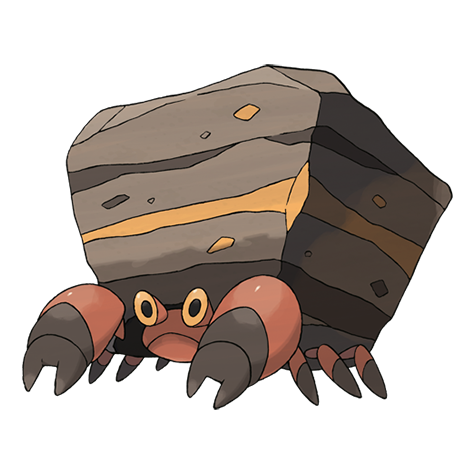

How is visual size determined?
Pokédex height is treated as the official listed measurement, but the chart uses pose-aware visual scaling so each sprite looks reasonable in a direct comparison.
For long or coiled Pokémon, the listed height may represent total body length rather than upright height. For Pokémon with floppy ears, leaves, feathers, antennae, wings, or other flexible features, the chart usually measures to the top of the solid, substantial part of the head or body instead of the tallest decorative feature.
The goal is not to replace the official height, but to make the artwork compare naturally at the size it appears to occupy.