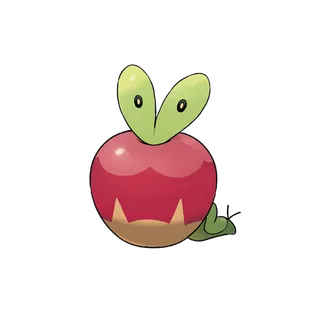
Applin is a Grass/Dragon-type Pokémon introduced in Generation VIII and the first stage of its evolution line, with a base stat total of 260.
Applin


Abilities
Ripens Berries and doubles their effect.
Encourages the early use of a held Berry.
Protects the Pokémon from some ball and bomb moves.
Hidden AbilityBase Stats
Applin's Weaknesses and Resistances





Evolution Chain
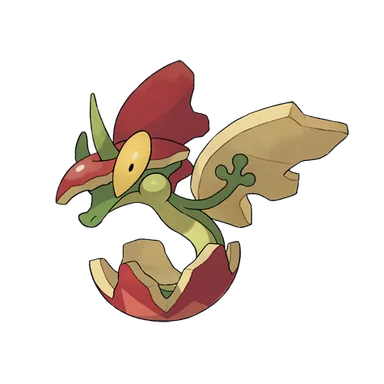
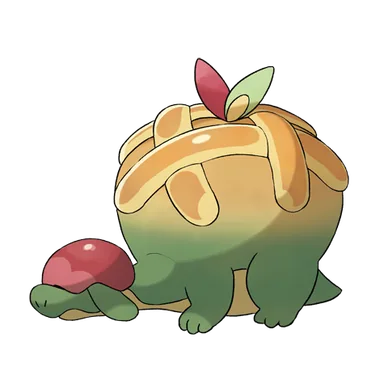
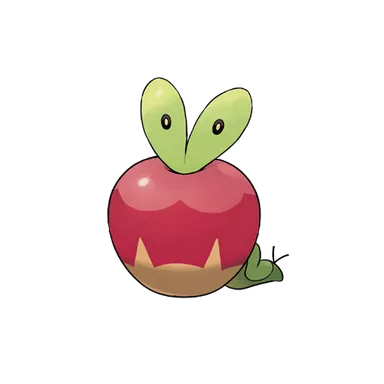
Applin can evolve into Flapple with a Tart Apple, Appletun with a Sweet Apple, or Dipplin with a Syrupy Apple, and Dipplin evolves into Hydrapple by leveling up knowing Dragon Cheer.
 Applin
 Flapple
 Appletun
 Dipplin
 Hydrapple
Applin Playthrough, Competitive, and Nuzlocke Usage
Using Applin in a Playthrough
Applin has one of the most complicated branching evolution families in the series: a Tart Apple produces Flapple, a Sweet Apple produces Appletun, while a Syrupy Apple introduced in Kitakami produces Dipplin, which then evolves into Hydrapple after leveling up while knowing Dragon Cheer. In Sword and Shield the two original apples are strongly associated with opposite versions, making the player's branch choice partly version-dependent without trading, while Scarlet/Violet and its DLC make the full family much easier to access in one save. Flapple is the fast physical branch with base 110 Attack and 70 Speed, using Grav Apple, Dragon STAB, U-turn, and Hustle or Ripen; Hustle raises Attack by 50% but reduces the accuracy of physical attacks, which is a major reliability tradeoff in ordinary play. Appletun is the slow bulky special branch with base 110 HP, 100 Special Attack, Recover, and Apple Acid, whose guaranteed Special Defense drop can steadily increase damage; Thick Fat is especially useful because it halves incoming Fire- and Ice-type damage calculations and partially offsets the family's disastrous 4× Ice weakness. Dipplin is more defensive than Applin's original branches and can use Eviolite before becoming Hydrapple, while Hydrapple finishes with base 106 HP, 110 Defense, 120 Special Attack, Regenerator, Nasty Plot, Giga Drain, and Fickle Beam, making it the family's strongest sustained special attacker and pivot. All branches remain Grass/Dragon, granting strong resistances to Water, Electric, and Grass but weaknesses to Bug, Dragon, Fairy, Flying, and Poison plus a 4× Ice weakness, so the choice of evolution changes stats and Abilities far more than the type chart. Flapple and Appletun can Gigantamax in Sword/Shield and share the same outward Gigantamax body, but G-Max Tartness lowers opponents' evasiveness while G-Max Sweetness cures the user's side of status conditions. Adamant or Jolly suit Flapple, Bold or Modest fit Appletun, and Hydrapple commonly benefits from Modest or Quiet because its low base 44 Speed makes raw special power more important than trying to outrun ordinary offensive Pokémon.
Applin in Competitive Pokémon
The Applin family spans several very different competitive power levels, from low-tier Flapple and Appletun to current UU Hydrapple. In Sword and Shield, Flapple is ZU and relies on Hustle-boosted physical attacks, Dragon Dance, Grav Apple, Outrage, and coverage to threaten teams, but Hustle's accuracy penalty makes its strongest physical sets inconsistent and the 4× Ice weakness reduces defensive opportunities. Appletun is also a lower-tier Pokémon, using 110 HP, Thick Fat or Ripen, Recover, Leech Seed, Apple Acid, and Dragon coverage to function as a bulky Grass-type, though passivity, poor base 30 Speed, and numerous weaknesses keep it from higher usage. Generation IX expanded the family dramatically: Dipplin debuted as an NFE Pokémon with 80/110/80 bulk, Recover, Eviolite, Sticky Hold or Supersweet Syrup, and enough defensive utility to earn legitimate PU and ZU use even before its evolution was released. Hydrapple currently sits in UU and represents a clear competitive upgrade, combining 106 HP, 110 Defense, 120 Special Attack, Regenerator, Nasty Plot, Giga Drain, Earth Power or coverage, and the accurate Fickle Beam, whose 80 base power has a 30% chance to double. Regenerator is particularly important because switching restores one third of Hydrapple's maximum HP, letting it repeatedly pivot into Water-, Ground-, Grass-, and Electric-oriented threats without relying solely on Recover. Flapple and Appletun remain ZU in current Scarlet/Violet while Hydrapple's UU placement shows how a later cross-generational evolution can transform an otherwise low-tier family without retroactively making the older branches competitive staples. The family's history is therefore unusually broad: multiple branching roles share the same Grass/Dragon typing, but their actual competitive success depends on radically different stat distributions, recovery tools, and Abilities.
Applin in Nuzlockes
Applin's family rewards planning in a Nuzlocke because the evolution item determines the entire long-term role of the encounter, and later games add a genuine choice between immediate final evolutions and the longer Dipplin-to-Hydrapple route. Flapple provides earlier physical offense and better Speed, but Hustle's accuracy penalty is dangerous in permadeath play and should not be treated as free power; Ripen is often safer if the player wants predictable Berry utility. Appletun is generally the safer original branch because high HP, Recover, Apple Acid, and especially Thick Fat can create substantial staying power, although its base 30 Speed means it normally has to absorb a hit before acting. Dipplin can be remarkably durable with Eviolite, Recover, and Sticky Hold, but evolving it into Hydrapple requires access to Dragon Cheer and a level-up, so the player needs to plan around DLC progression rather than assuming a normal level threshold will trigger evolution. Hydrapple is excellent for long-term survival thanks to Regenerator, strong physical bulk, Giga Drain, and high Special Attack, but none of the branches escape the 4× Ice weakness, which remains the most dangerous matchup across the entire family. Accurate Apple Acid, Giga Drain, and Fickle Beam are preferable to unnecessary reliance on low-accuracy options, while recovery and switching should be used proactively because the family's low or middling Speed often gives opponents the first move. From a safety perspective, Appletun and Hydrapple generally provide the greatest margin for error, whereas Flapple offers faster offense at the cost of accuracy and defensive reliability.
Learnsets
8 moves · Scarlet Violet
Level Up



Machine


Egg


Pokédex Entries
2 entries
It spends its entire life inside an apple. It hides from its natural enemies, bird Pokémon, by pretending it’s just an apple and nothing more.
As soon as it’s born, it burrows into an apple. Not only does the apple serve as its food source, but the flavor of the fruit determines its evolution.
Where To Find Applin
1 locations
Route 5 · GalarWalking · version details vary
Route 5
Additional Images
PokeAPI sprites
Open this section to load extra PokeAPI sprite images.
Applin Biology and Behavior
Applin is born with a small, vulnerable body and quickly burrows into an apple that becomes simultaneously its home, food source, disguise, and protection from bird Pokémon. Body fluids produced by Applin prevent the fruit from rotting and strengthen the rind, allowing the apple to function as a durable protective structure rather than ordinary food. If separated from the apple or deprived of replacement fruit, Applin loses moisture and becomes weak from dehydration. Its disguise is imperfect against fruit-eating predators such as Noibat, which may mistake the occupied apple for food. In Galar, giving another person an Applin is a traditional romantic gesture, giving the species a cultural role beyond its natural ecology. The flavor and preparation of the apple later determine which evolutionary path the Pokémon follows.
Applin Biological Data
- National Pokédex
- #840
- Species
- Apple Core Pokémon
- Height
- 0' 8" (0.2 m)
- Weight
- 1.1 lbs (0.5 kg)
- Habitat
- Currently Unknown
- Color
- Green
- Body Style
- Squiggle
- Gender
- 50% female / 50% male
Misc
Catch Rate: 255
Base Experience: 52 Exp
Hatch Counter: 20
Applin Size Comparison: BETA
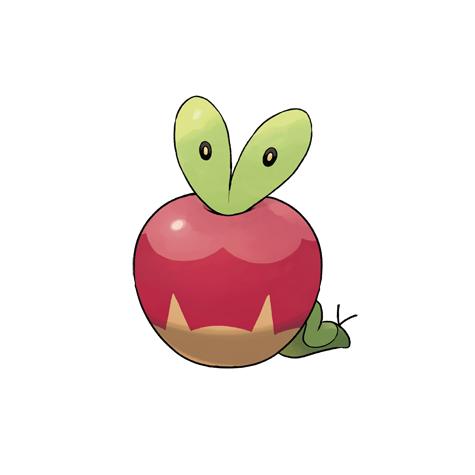
Applin is listed at 0' 8" (0.2 m) and shown in an in-chart visual comparison.

How is visual size determined?
Pokédex height is treated as the official listed measurement, but the chart uses pose-aware visual scaling so each sprite looks reasonable in a direct comparison.
For long or coiled Pokémon, the listed height may represent total body length rather than upright height. For Pokémon with floppy ears, leaves, feathers, antennae, wings, or other flexible features, the chart usually measures to the top of the solid, substantial part of the head or body instead of the tallest decorative feature.
The goal is not to replace the official height, but to make the artwork compare naturally at the size it appears to occupy.