Orthworm is a Steel-type Pokémon introduced in Generation IX, with a base stat total of 480 and no standard evolutions.
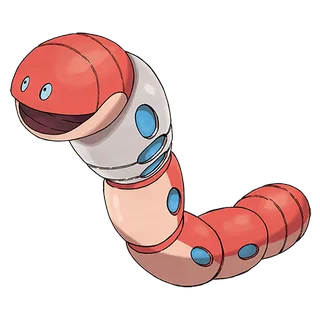
Orthworm

Abilities
If hit by a Ground-type move, the Pokémon has its HP restored instead of taking damage.
Ups evasion in a sandstorm.
Hidden AbilityBase Stats
Orthworm's Weaknesses and Resistances





Evolution Chain
Orthworm does not evolve into or from any other Pokémon.
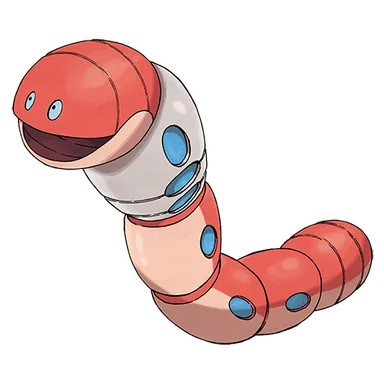 Orthworm
 Playthrough, Competitive, and Nuzlocke Usage
Using Orthworm in a Playthrough
Orthworm is a standalone pure Steel-type whose defining playthrough trait is Earth Eater, an Ability that converts the normally super-effective Ground type into an immunity and heals Orthworm for one-quarter of its maximum HP when a Ground move hits it. That dramatically improves an already excellent physical defensive profile built around base 145 Defense and Steel's many resistances, allowing Orthworm to switch into physical Ground attacks that would destroy most Steel-types. Its weaknesses are therefore primarily Fire and Fighting when Earth Eater is active, while base 55 Special Defense remains a much broader vulnerability even against neutral special attacks. Body Press takes advantage of its enormous Defense, and Iron Defense or Coil can make it increasingly difficult for physical opponents to break; Stealth Rock and Spikes add useful team support. Orthworm also learns Shed Tail at level 52 in Scarlet/Violet, but unlike Regenerator Cyclizar it has no automatic switching recovery, so sacrificing half of its maximum HP is a significant cost despite the value of passing a substitute. Terastallization can change its defensive matchups, though losing Steel's excellent resistance profile or Earth Eater's Ground interaction should be weighed carefully. Impish maximizes physical durability and Body Press potential, while Careful can help patch the much weaker Special Defense.
Orthworm in Competitive Pokémon
Orthworm has had two distinct competitive identities in Generation IX: early in the generation it was one of the few Shed Tail users, but standard SV OU later banned Shed Tail itself, removing that strategy from ordinary OU play. Its current SV placement is ZU, where it instead succeeds as a physically defensive Steel-type built around base 145 Defense, Earth Eater, entry hazards, and Body Press. Earth Eater is especially valuable because it turns Steel's Ground weakness into both an immunity and 25% healing, creating opportunities against Pokémon that would normally pressure Steel-types with Earthquake. Stealth Rock and Spikes allow Orthworm to function as a hazard setter, while Iron Defense or Coil can convert its physical bulk into a Body Press win condition. The weaknesses that prevent it from climbing higher are clear: base 55 Special Defense makes strong special attackers threatening, it lacks reliable ordinary recovery, and losing Leftovers or being repeatedly forced into Fire and Fighting attacks wears it down quickly. The newer Pokémon Champions environment is materially different: Smogon's current Champions Pokédex places Orthworm in UU, and Shed Tail is once again available to it there, so that format restores part of the support identity that standard SV tiering removed. This distinction is important because its ZU status in SV and its UU status in Champions refer to different rulesets rather than a single uninterrupted metagame.
Orthworm in Nuzlockes
Earth Eater makes Orthworm one of the safer specialist switch-ins available in Paldea because a correctly predicted Ground attack not only deals no damage but restores one-quarter of its maximum HP. Base 145 Defense and Steel's extensive resistance list let it absorb many physical attacks with a large margin for error, and Body Press turns that defensive investment into meaningful offensive pressure. The danger is special damage: base 55 Special Defense is low enough that even neutral special attacks can remove large portions of its HP, while Fire and Fighting moves remain super effective. Iron Defense and Coil can dominate known physical matchups, but setup should not be attempted blindly against opponents that may carry special coverage or critical-hit opportunities. Shed Tail is powerful support but costs half of Orthworm's maximum HP and, unlike Cyclizar, Orthworm lacks Regenerator to restore that sacrifice automatically; in a Nuzlocke it should therefore be reserved for situations where the substitute meaningfully reduces greater danger. Stealth Rock and Spikes are safe long-term utility options when the opponent cannot threaten Orthworm directly. Impish is excellent for maximizing its defining physical role, while Careful improves overall balance and may be preferable when surviving mixed boss movesets matters more than maximizing Body Press.
Learnsets
54 moves · Scarlet Violet
Level Up



Machine

Egg
Pokédex Entries
2 entries
When attacked, this Pokémon will wield the tendrils on its body like fists and pelt the opponent with a storm of punches.
This Pokémon lives in arid deserts. It maintains its metal body by consuming iron from the soil.
Additional Images
PokeAPI sprites
Open this section to load extra PokeAPI sprite images.
Orthworm Biology and Behavior
Orthworm is a long, six-segmented metallic worm whose second body segment can extend multiple blue parapodia-like appendages resembling simple fists. It lives in arid deserts and maintains its metal body by consuming iron from the soil, sometimes remaining buried with only its head exposed. When threatened, Orthworm extends its fist-like tendrils and pelts attackers with a rapid series of blows. A particularly enormous individual in East Province (Area Three) became the Lurking Steel Titan after feeding on Salty Herba Mystica, demonstrating that exceptional diet can produce a dramatically oversized specimen.
Orthworm Biological Data
- National Pokédex
- #968
- Species
- Earthworm Pokémon
- Height
- 8' 2" (2.5 m)
- Weight
- 683.4 lbs (310.0 kg)
- Habitat
- Currently Unknown
- Color
- Pink
- Body Style
- Squiggle
- Gender
- 50% female / 50% male
Misc
Catch Rate: 25
Base Experience: 240 Exp
Hatch Counter: 35
Orthworm Size Comparison: BETA
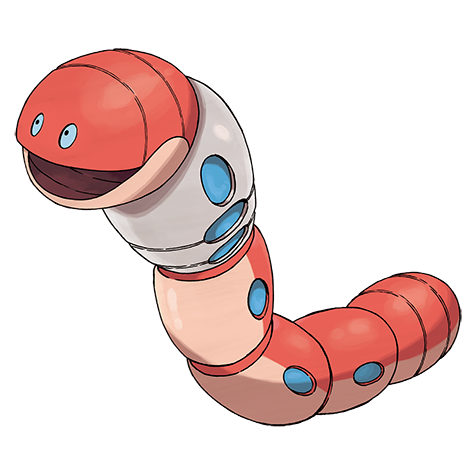
Orthworm is listed at 8' 2" (2.5 m) and shown in an in-chart visual comparison.

How is visual size determined?
Pokédex height is treated as the official listed measurement, but the chart uses pose-aware visual scaling so each sprite looks reasonable in a direct comparison.
For long or coiled Pokémon, the listed height may represent total body length rather than upright height. For Pokémon with floppy ears, leaves, feathers, antennae, wings, or other flexible features, the chart usually measures to the top of the solid, substantial part of the head or body instead of the tallest decorative feature.
The goal is not to replace the official height, but to make the artwork compare naturally at the size it appears to occupy.