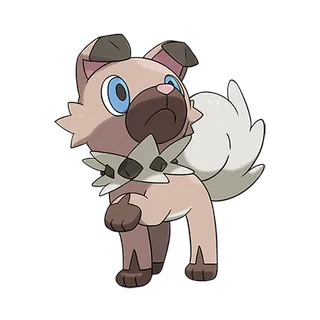
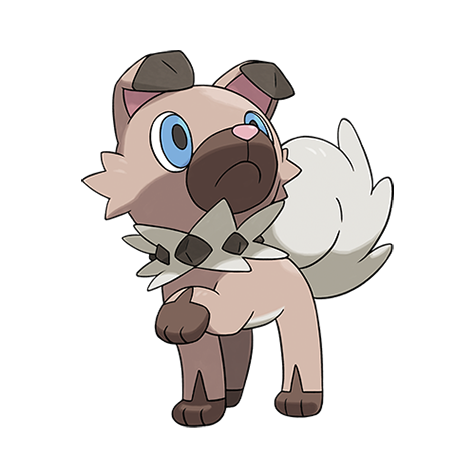
Rockruff is a Rock-type Pokémon introduced in Generation VII and the first stage of its evolution line, with a base stat total of 280.
Rockruff

Abilities
Prevents loss of accuracy.
Prevents sleep.
Raises Speed each time the Pokémon flinches.
Hidden AbilityBase Stats
Rockruff's Weaknesses and Resistances







Evolution Chain
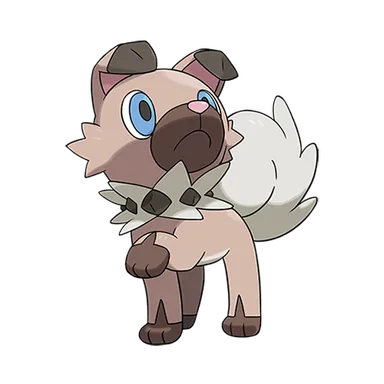
Rockruff evolves into Lycanroc Midday by leveling up at level 25during the day.
 Rockruff
 Lycanroc Midday
Forms
 Rockruff Own Tempo
Rockruff Playthrough, Competitive, and Nuzlocke Usage
Using Rockruff in a Playthrough
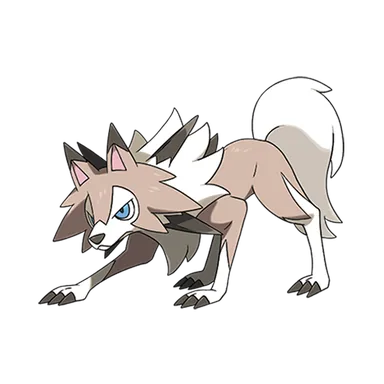
Rockruff evolves beginning at level 25, but the desired Lycanroc form must be planned around both time and Ability: ordinary Rockruff becomes Midday Form during the day or Midnight Form at night, while only the separate Own Tempo Rockruff can become Dusk Form during the evening. Generation VII adds version restrictions—Sun and Ultra Sun naturally produce Midday while Moon and Ultra Moon produce Midnight—and Own Tempo Rockruff was originally event-exclusive in Ultra Sun and Ultra Moon, whereas later games make the form easier to obtain. All three evolutions remain pure Rock physical attackers, but their stat distributions and Abilities create clearly different roles: Midday is fastest at base 112 Speed and can use Sand Rush, Midnight trades Speed for greater bulk and can use No Guard for perfectly accurate Stone Edge, and Dusk combines base 117 Attack with base 110 Speed and Tough Claws. Midday and Dusk also have access to Accelerock, a reliable Rock-type priority attack that is particularly useful for finishing faster weakened foes, while Dusk's Tough Claws boosts many of the contact coverage moves it already wants to use. Pure Rock typing supplies useful Fire, Flying, Normal, and Poison resistances but leaves all forms weak to Fighting, Grass, Ground, Steel, and Water, and none has the bulk to ignore strong super-effective attacks. Jolly is excellent for Midday and Dusk when preserving their natural Speed is important, while Adamant is a legitimate damage-focused alternative; Midnight is more comfortable with Adamant because its lower Speed makes raw power and No Guard reliability more central to its role.
Rockruff in Competitive Pokémon
The three Lycanroc forms have never been competitively equivalent despite sharing a species and pure Rock typing. Midday Form was PU in Generation VII, where base 112 Speed, Swords Dance, Accelerock, and the Lycanium Z-powered Splintered Stormshards gave it a respectable late-game sweeping role, and it continues to find lower-tier value as a fast attacker, hazard lead, or Sand Rush cleaner. Midnight Form has historically been the weakest of the three in singles: it was ZU in Generation VII and remains a lower-tier option, with No Guard granting the genuinely useful niche of perfectly accurate Stone Edge but not compensating fully for base 82 Speed, common weaknesses, and competition from faster Rock attackers. Dusk Form immediately occupied a stronger position, landing in RU in Generation VII because Tough Claws, base 117 Attack, base 110 Speed, Swords Dance, Accelerock, and its exclusive Z-Move made it an imposing wallbreaker; in Sword and Shield it rose to UU and remained valued as a fast revenge killer. In Scarlet and Violet, Dusk is currently NUBL and receives RU analysis, with Tough Claws-boosted coverage plus Accelerock and Sucker Punch preserving its role as a wallbreaker, cleaner, or setup sweeper, while Midday and Midnight reside much lower. The line illustrates how a small stat redistribution and one excellent Ability can matter more competitively than a shared typing: Dusk's Tough Claws and offensive stat line consistently give it the most serious singles presence, Midday's Speed grants a real niche, and Midnight's No Guard Stone Edge is useful but comparatively narrow.
Rockruff in Nuzlockes
Rockruff's level-25 evolution is early enough to be practical, but the safest form depends on what the run values more: natural Speed, reliable Rock STAB, or stronger priority. Midday Form's base 112 Speed and Accelerock make it the easiest form to use for clean revenge kills, reducing the number of turns in which it must absorb damage; Dusk offers similar Speed, more Attack, Tough Claws, and the same priority, making it especially strong when Own Tempo Rockruff is legitimately obtainable. Midnight Form's No Guard removes Stone Edge's dangerous accuracy variance, a real Nuzlocke advantage, but No Guard also means opposing attacks cannot miss, and its base 82 Speed forces it to take more hits than the other forms. All three are pure Rock and share five weaknesses, so none should be treated as a general-purpose tank even when resisting the opponent's primary STAB; Water, Ground, Fighting, Steel, and Grass coverage must be checked carefully. Accelerock is one of the line's best permadeath tools because priority can remove a weakened threat without risking a Speed tie or an unexpected Choice Scarf, while Sucker Punch on appropriate sets is useful but less deterministic because it can fail against status moves. Swords Dance can enable sweeps from a genuinely safe matchup, but the forms' modest defenses make greedy setup dangerous, and recoil or Defense-dropping coverage should be avoided when a safer move still secures the knockout.
Learnsets
55 moves · Scarlet Violet
Level Up



Machine




Egg
Pokédex Entries
6 entries
It’s considered to be a good Pokémon for beginners because of its friendliness, but its disposition grows rougher as it grows up.
This Pokémon has lived with people since times long ago. It can sense when its Trainer is in the dumps and will stick close by its Trainer’s side.
As they develop, their disposition grows more violent and aggressive. Many Trainers find them too much to handle and abandon them.
When it rubs the rocks on its neck against you, that’s proof of its love for you. However, the rocks are sharp, so the gesture is quite painful!
This Pokémon can bond very strongly with its Trainer, but it also has a habit of biting. Raising a Rockruff for a long time can be challenging.
This Pokémon intimidates opponents by striking the ground with the rocks on its neck. The moment an opponent flinches, Rockruff attacks.
Where To Find Rockruff
2 locations
Route 1 · AlolaWalking · version details vary
Alola Route 1 South
Ten Carat Hill · AlolaWalking · version details vary
Ten Carat Hill Farthest Hollow
Additional Images
PokeAPI sprites
Open this section to load extra PokeAPI sprite images.
Rockruff Biology and Behavior
Rockruff is a canine Pokémon with small rocks embedded in the fur around its neck, and it has an exceptionally strong sense of smell that allows it to remember an odor permanently. Stories describe Rockruff following a faint remembered scent to reunite with a Trainer after becoming separated, and the species has lived alongside humans since ancient times. Young Rockruff are friendly and bond readily, but as evolution approaches they become increasingly unruly and independent, begin howling at sunset, and may disappear from their Trainer before later returning as Lycanroc. Wild Rockruff travel in packs until they evolve, and their persistent temperament is expressed by repeatedly attacking even much stronger opponents. They strike the ground with the stones in their neck ruff to intimidate enemies and have territorial conflicts with Growlithe.
Rockruff Biological Data
- National Pokédex
- #744
- Species
- Puppy Pokémon
- Height
- 1' 8" (0.5 m)
- Weight
- 20.3 lbs (9.2 kg)
- Habitat
- Currently Unknown
- Color
- Brown
- Body Style
- Quadruped
- Gender
- 50% female / 50% male
Misc
Catch Rate: 190
Base Experience: 56 Exp
Hatch Counter: 15
Rockruff Size Comparison: BETA
Rockruff is listed at 1' 8" (0.5 m); this chart uses a pose-adjusted visual scale.

How is visual size determined?
Pokédex height is treated as the official listed measurement, but the chart uses pose-aware visual scaling so each sprite looks reasonable in a direct comparison.
For long or coiled Pokémon, the listed height may represent total body length rather than upright height. For Pokémon with floppy ears, leaves, feathers, antennae, wings, or other flexible features, the chart usually measures to the top of the solid, substantial part of the head or body instead of the tallest decorative feature.
The goal is not to replace the official height, but to make the artwork compare naturally at the size it appears to occupy.
Rockruff currently uses a pose-adjusted visual scale.