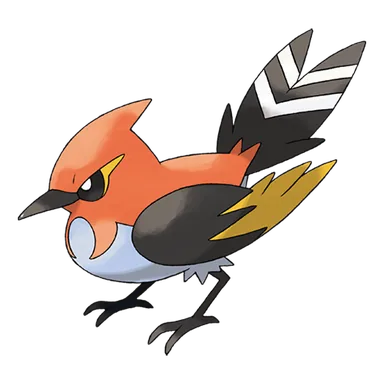
Fletchling is a Normal/Flying-type Pokémon introduced in Generation VI and the first stage of its evolution line, with a base stat total of 278.
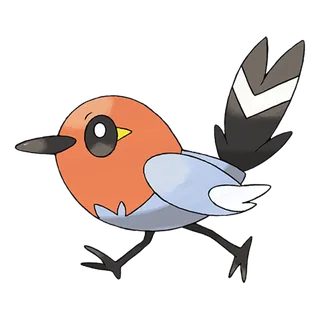
Fletchling


Abilities
Protects the Pokémon from Defense-lowering attacks.
Gives priority to Flying-type moves.
Hidden AbilityBase Stats
Fletchling's Weaknesses and Resistances




Evolution Chain
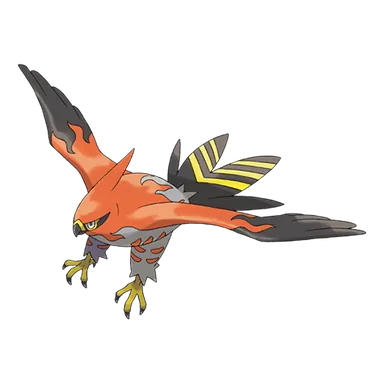
Fletchling evolves into Fletchinder at level 17, and Fletchinder evolves into Talonflame at level 35.
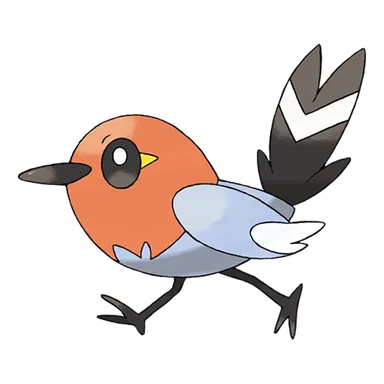 Fletchling
 Fletchinder

 Talonflame
Fletchling Playthrough, Competitive, and Nuzlocke Usage
Using Fletchling in a Playthrough
Fletchling evolves into Fletchinder at level 17 and Talonflame at level 35, giving Kalos an unusually fast and offensively useful regional bird. Talonflame is Fire/Flying with base 126 Speed but only base 81 Attack, so Brave Bird and Flare Blitz supply most of its raw physical damage while Roost, U-turn, Will-O-Wisp, Taunt, Swords Dance, and Tailwind provide utility. Flame Body can burn opponents that make contact, while the Hidden Ability Gale Wings is historically crucial: in Generation VI it gives +1 priority to all Flying-type moves, including Brave Bird, Roost, and Tailwind, whereas from Generation VII onward it works only while Talonflame is at full HP. Fire/Flying grants a Ground immunity and several useful resistances, but Water and Electric are super effective and Rock deals quadruple damage. Jolly is usually unnecessary for many Gen VI priority sets but remains useful for ordinary attacks and later generations, while Adamant improves the modest base Attack. Recoil from both Brave Bird and Flare Blitz is the main story-play risk.
Fletchling in Competitive Pokémon
Talonflame was an XY OU staple despite mediocre attacking and defensive stats because Gale Wings fundamentally changed how teams handled speed. In Generation VI, priority Brave Bird let Talonflame revenge kill faster threats and weakened sweepers regardless of their Speed stat, while priority Roost, Tailwind, and other Flying utility gave it unusual support options; Smogon described it as a premier revenge killer and late-game cleaner. It was also highly important in VGC 2014, where Gale Wings Brave Bird and Tailwind provided immediate offensive and speed-control pressure. The Generation VII nerf requiring full HP for Gale Wings dramatically reduced this dominance, especially because Brave Bird recoil and Stealth Rock damage easily disable the ability. Talonflame has remained useful in later lower tiers through base 126 Speed, Flame Body, Will-O-Wisp, Taunt, Roost, and momentum, but its competitive peak is inseparable from the original Generation VI version of Gale Wings.
Fletchling in Nuzlockes
Talonflame is extremely useful in a Nuzlocke because it evolves at normal levels, reaches base 126 Speed, and gains a Ground immunity plus valuable Fire and Fighting resistances. The major danger is self-inflicted damage: Brave Bird and Flare Blitz both cause recoil, so repeatedly using maximum-power STAB can leave Talonflame vulnerable even when every opponent is knocked out. Rock attacks are especially dangerous because they deal quadruple damage, and Stealth Rock can remove half of Talonflame's HP on entry before Heavy-Duty Boots exist. In Generation VI, Gale Wings priority can make Brave Bird and Roost exceptionally safe emergency tools; from Generation VII onward the ability works only at full HP, so even minor chip damage removes that advantage. Flame Body can occasionally neutralize a contact attacker with burn, but the activation chance is not reliable enough to build a survival plan around.
Learnsets
46 moves · Scarlet Violet
Level Up





Machine


Egg

Pokédex Entries
8 entries
These friendly Pokémon send signals to one another with beautiful chirps and tail-feather movements.
Despite the beauty of its lilting voice, it’s merciless to intruders that enter its territory.
This amiable Pokémon is easy to train. But when battle is joined, it shows its ferocious side.
When it’s excited, its temperature can double, spiking hormone production in its body.
While it’s an amiable Pokémon, if you touch it unexpectedly, it will heat up its body in an instant, and you’ll be burned.
Its body is always warm. Trainers who live in cold areas apparently sleep with it in their bed.
Its melodious cries are actually warnings. Fletchling will mercilessly peck at anything that enters its territory.
When this Pokémon gets excited, its body temperature increases sharply. If you touch a Fletchling with bare hands, you might get burned.
Where To Find Fletchling
6 locations
Poké Pelago · AlolaGift · version details vary
Poke Pelago Elite Four Defeated
Poke Pelago Poni Island Reached
Poke Pelago Ulaula Island Reached
Route 8 · AlolaWalking · version details vary
Alola Route 8 Main
Wela Volcano Park · AlolaWalking · version details vary
Wela Volcano Park Area
Route 2 · KalosWalking · version details vary
Road 2
Route 3 · KalosWalking · version details vary
Road 3
Santalune Forest · KalosWalking · version details vary
Santalune Forest
Additional Images
PokeAPI sprites
Open this section to load extra PokeAPI sprite images.
Fletchling Biology and Behavior
Fletchling is a small robin-like Pokemon known for a pleasant song and apparently friendly behavior. That song often functions as a warning rather than simple social display, and Fletchling can become unexpectedly aggressive toward intruders. It communicates with flockmates through chirps and movements of its tail feathers. The species feeds on small prey and plant material and gradually develops the fiery traits that become dominant after evolution.
Fletchling Biological Data
- National Pokédex
- #661
- Species
- Tiny Robin Pokémon
- Height
- 1' 0" (0.3 m)
- Weight
- 3.7 lbs (1.7 kg)
- Habitat
- Currently Unknown
- Color
- Red
- Body Style
- Wings
- Gender
- 50% female / 50% male
Misc
Catch Rate: 255
Base Experience: 56 Exp
Hatch Counter: 15
Fletchling Size Comparison: BETA
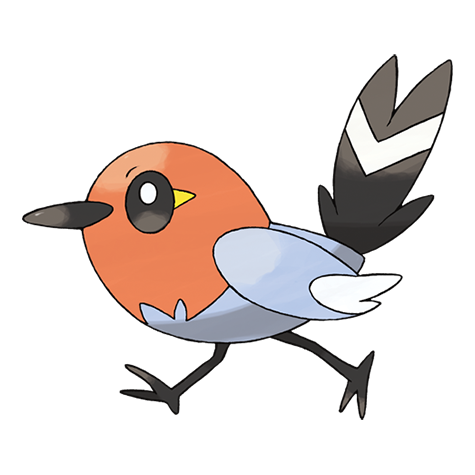
Fletchling is listed at 1' 0" (0.3 m); this chart uses a pose-adjusted visual scale.

How is visual size determined?
Pokédex height is treated as the official listed measurement, but the chart uses pose-aware visual scaling so each sprite looks reasonable in a direct comparison.
For long or coiled Pokémon, the listed height may represent total body length rather than upright height. For Pokémon with floppy ears, leaves, feathers, antennae, wings, or other flexible features, the chart usually measures to the top of the solid, substantial part of the head or body instead of the tallest decorative feature.
The goal is not to replace the official height, but to make the artwork compare naturally at the size it appears to occupy.
Fletchling currently uses a pose-adjusted visual scale.