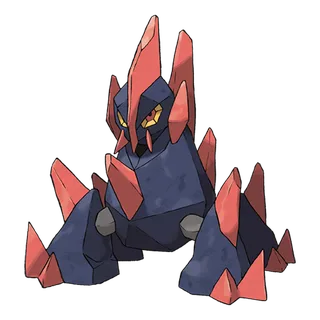
Gigalith is a Rock-type Pokémon introduced in Generation V and a final stage of its evolution line, with a base stat total of 515.
Gigalith

Abilities
Negates 1-hit KO attacks.
Summons a sandstorm.
Boosts certain moves’ power in a sandstorm.
Hidden AbilityBase Stats
Gigalith's Weaknesses and Resistances







Evolution Chain
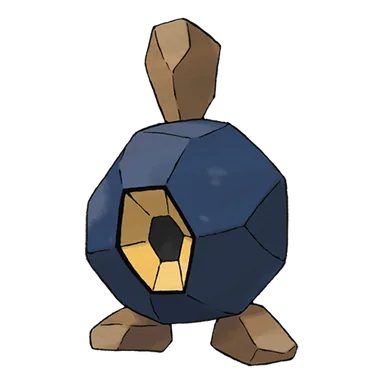
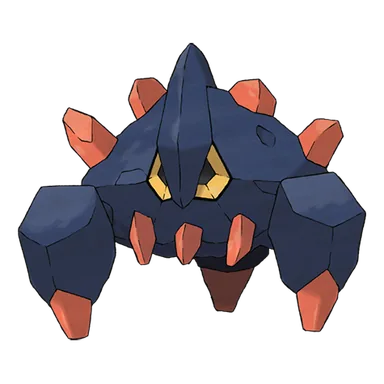
Roggenrola evolves into Boldore at level 25, and Boldore evolves into Gigalith by trading.
 Roggenrola
 Boldore
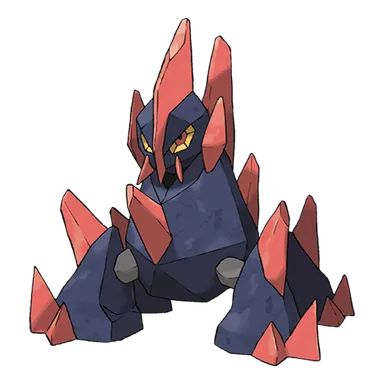 Gigalith
 Playthrough, Competitive, and Nuzlocke Usage
Using Gigalith in a Playthrough
Roggenrola evolves into Boldore at level 25 and then into Gigalith through trading, making access to the final stage dependent on another player or an equivalent trade feature in most games. Gigalith is extremely slow at base 25 Speed but has enormous base 135 Attack and 130 Defense, while its Special Defense increased from 70 to 80 beginning in Generation VII. Rock Slide or Stone Edge provides strong STAB, with Rock Blast, Earthquake, Heavy Slam, Body Press in later games, Stealth Rock, and Explosion or utility options giving it both offensive and support roles. Sturdy guarantees survival from full HP against a single otherwise fatal hit in modern mechanics, Sand Force boosts Rock-, Ground-, and Steel-type attacks in sand, and from Generation VII onward Gigalith gained Sand Stream as a standard ability, automatically summoning sand and increasing its own Special Defense by 50 percent because it is a Rock-type. Brave is excellent under Trick Room and Adamant suits ordinary physical offense, while the trade requirement means Boldore itself may need to serve as the final form in runs where trading is unavailable.
Gigalith in Competitive Pokémon
Gigalith began BW competitive play as a slow lower-tier Rock attacker whose defining tools were base 135 Attack, base 130 Defense, Sturdy, and excellent performance under Trick Room. Smogon placed it in BW NU and highlighted Sturdy as effectively providing a built-in Focus Sash, while Rock Slide or Rock Blast, Earthquake, Choice Band, and even Explosion made it capable of dealing enormous physical damage despite rock-bottom base 25 Speed. Generation VII dramatically improved Gigalith by increasing Special Defense from 70 to 80 and giving it Sand Stream; sand automatically boosts a Rock-type's Special Defense by 50 percent, turning Gigalith into an unusually durable weather setter rather than merely a slow attacker. In SM it reached RU and also became an important VGC 2017 weather Pokemon, supporting partners such as Sand Rush Stoutland while functioning exceptionally well under Trick Room. Later formats continued to use it as a bulky sand setter, Stealth Rock user, and physical tank, making Gigalith one of the clearer examples of a Pokemon whose competitive relevance improved substantially because of later-generation mechanical changes rather than a new evolution or form.
Gigalith in Nuzlockes
The Roggenrola line is very safe against many physical attacks because Boldore and Gigalith have enormous Defense and modern Sturdy can guarantee survival from full HP against a single otherwise lethal hit. That guarantee disappears once chip damage, status, weather, or hazards break full health, so keeping Sturdy intact can be more important than maximizing damage in a dangerous fight. Water, Grass, Fighting, Ground, and Steel attacks are all super effective, and Gigalith's extremely low Speed means one of those attacks will almost always land before it responds. Sand Stream from Generation VII onward improves special durability substantially but can also chip teammates that are not immune to sand, while Stone Edge and Rock Slide introduce accuracy concerns compared with weaker but safer alternatives. The biggest practical issue is the trade evolution: where trading is unavailable, Boldore may be the endpoint, so a Nuzlocke should not assume access to Gigalith unless its evolution method is actually possible under the run's rules.
Learnsets
14 moves · Sword Shield
Level Up — Sword Shield



Pokédex Entries
9 entries
Compressing the energy from its internal core lets it fire off an attack capable of blowing away a mountain.
The solar energy absorbed by its body’s orange crystals is magnified internally and fired from its mouth.
The solar rays it absorbs are processed in its energy core and fired as a ball of light.
The blasts of energy it makes from sunbeams have terrifying power. However, it’s not able to fire its blasts at night or on rainy days.
Known for its hefty horsepower, this Pokémon is a popular partner for construction workers.
When it fires off energy with all its might, the power creates countless fissures on its body.
It absorbs rays of sunlight and shoots out energy. It’s usually lurking deep beneath the surface.
This hardy Pokémon can often be found on construction sites and in mines, working alongside people and Copperajah.
Although its energy blasts can blow away a dump truck, they have a limitation— they can only be fired when the sun is out.
Where To Find Gigalith
1 locations
Route 7 · UnovaNpc Trade · version details vary
Road 7
Held Items
2 items
- Black: 50% chance
- White: 50% chance
- Black 2: 50% chance
- White 2: 50% chance
- X: 50% chance
- Y: 50% chance
- Omega Ruby: 50% chance
- Alpha Sapphire: 50% chance
- Sun: 50% chance
- Moon: 50% chance
- Ultra Sun: 50% chance
- Ultra Moon: 50% chance
- Black: 5% chance
- White: 5% chance
- Black 2: 5% chance
- White 2: 5% chance
- X: 5% chance
- Y: 5% chance
- Omega Ruby: 5% chance
- Alpha Sapphire: 5% chance
- Sun: 5% chance
- Moon: 5% chance
- Ultra Sun: 5% chance
- Ultra Moon: 5% chance
Additional Images
PokeAPI sprites
Open this section to load extra PokeAPI sprite images.
Gigalith Biology and Behavior
Gigalith compresses tremendous energy inside its core and can release blasts powerful enough to destroy large objects or even blow away parts of mountains, although firing at maximum output can crack its own rocky body. Its orange crystals absorb sunlight and magnify that energy before Gigalith fires it from its mouth; this particular process cannot function effectively at night or during rain. The species lives deep in caves and tunnels and possesses enough raw strength to work alongside humans in mines and construction sites. In Galar, Gigalith is specifically known to partner with Copperajah on heavy construction and mining work.
Gigalith Biological Data
- National Pokédex
- #526
- Species
- Compressed Pokémon
- Height
- 5' 7" (1.7 m)
- Weight
- 573.2 lbs (260.0 kg)
- Habitat
- Currently Unknown
- Color
- Blue
- Body Style
- Tentacles
- Gender
- 50% female / 50% male
Misc
Catch Rate: 45
Base Experience: 232 Exp
Hatch Counter: 15
Gigalith Size Comparison: BETA
Gigalith is listed at 5' 7" (1.7 m) and shown in an in-chart visual comparison.
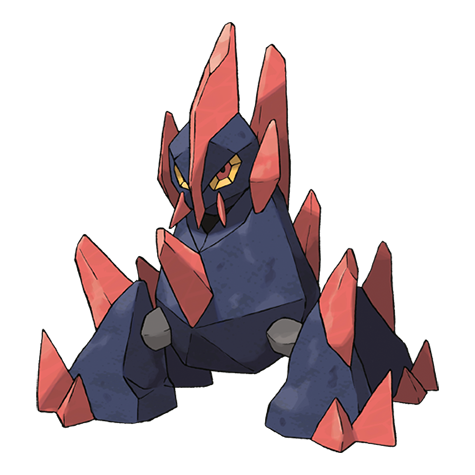

How is visual size determined?
Pokédex height is treated as the official listed measurement, but the chart uses pose-aware visual scaling so each sprite looks reasonable in a direct comparison.
For long or coiled Pokémon, the listed height may represent total body length rather than upright height. For Pokémon with floppy ears, leaves, feathers, antennae, wings, or other flexible features, the chart usually measures to the top of the solid, substantial part of the head or body instead of the tallest decorative feature.
The goal is not to replace the official height, but to make the artwork compare naturally at the size it appears to occupy.