Hippopotas is a Ground-type Pokémon introduced in Generation IV and the first stage of its evolution line, with a base stat total of 330.
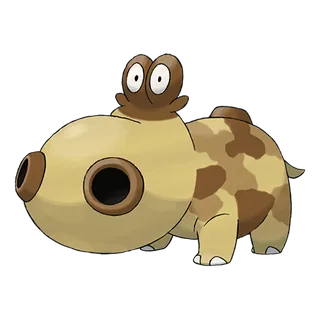
Hippopotas

Abilities
Summons a sandstorm.
Boosts certain moves’ power in a sandstorm.
Hidden AbilityBase Stats
Hippopotas's Weaknesses and Resistances






Evolution Chain
Hippopotas evolves into Hippowdon at level 34.
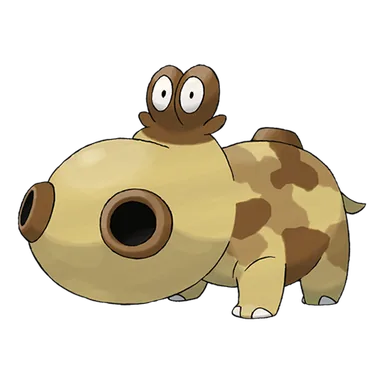 Hippopotas
 Hippowdon
Hippopotas Playthrough, Competitive, and Nuzlocke Usage
Using Hippopotas in a Playthrough
Hippopotas evolves into Hippowdon at level 34, producing a slow but exceptionally sturdy pure Ground-type with base 108 HP, 118 Defense, and 112 Attack. Earthquake gives it powerful and perfectly reliable physical STAB, while Crunch, Rock coverage, Yawn, Stealth Rock, Whirlwind, and especially Slack Off allow Hippowdon to alternate between direct offense and long-term defensive utility. Sand Stream automatically creates sand whenever Hippowdon enters battle, which can support Rock-, Ground-, and Steel-type teammates and enable sand-based abilities, but in generations before VI the weather lasts indefinitely and can also chip non-immune teammates throughout long fights. Its major weaknesses are Water, Grass, and Ice, and base 47 Speed means Hippowdon usually has to absorb an attack before responding; special attackers are considerably more dangerous than most physical ones because base 72 Special Defense is much less impressive than its physical bulk. Impish is an especially natural nature for defensive play, while Careful can patch the weaker special side, and the later Hidden Ability Sand Force is useful for personal damage in sand but usually gives up the broader team utility that makes Sand Stream so valuable.
Hippopotas in Competitive Pokémon
Hippowdon debuted as an important DPP OU Pokemon and one of the generation's premier physical walls, using enormous 108/118 physical bulk, Ground typing, reliable Slack Off, and Sand Stream to check threats such as Tyranitar while supporting the residual-damage style that defined many sand teams. Stealth Rock and Whirlwind gave it excellent hazard support and anti-setup utility, while Earthquake prevented it from becoming passive and Slack Off allowed it to repeatedly perform those jobs over a long match. It remained highly relevant in BW OU, where permanent sand from Sand Stream was strategically important in the weather wars and Hippowdon offered a bulkier alternative to Tyranitar as a sand setter. Later generations removed permanent weather, but Hippowdon continued appearing in OU, UU, and RU environments as a physical wall, rocker, phazer, and sand enabler because its fundamental defensive package changed very little. Its weaknesses have also remained consistent: strong Water-, Grass-, and Ice-type special attackers can overwhelm it, status and Knock Off can reduce its longevity, and its poor Speed leaves it vulnerable to Taunt, but few Ground-types have matched its combination of recovery, weather, hazards, and raw physical durability across so many generations.
Hippopotas in Nuzlockes
Hippowdon is one of the safer physical tanks available in a Nuzlocke because base 108 HP and 118 Defense give it an unusually large margin against neutral physical attacks, while an Electric immunity and resistances to Rock and Poison create predictable switching opportunities. Slack Off is especially valuable under permadeath rules because it allows repeated reliable healing without consuming items, and Yawn can force dangerous opponents out or create safer turns without relying on inaccurate sleep moves. Sand Stream is a mixed blessing: the passive damage can break enemy Focus Sashes and steadily wear opponents down, but it also chips teammates that are not Rock-, Ground-, or Steel-type and can complicate long battles if weather cannot be removed. Water, Grass, and Ice moves are the obvious threats, but the weaker base 72 Special Defense means even strong neutral special attacks deserve more respect than Hippowdon's enormous physical bulk might suggest. An Impish or Careful nature can further improve its safety, and the best Nuzlocke use is usually deliberate defensive switching and recovery rather than attempting to brute-force special attackers simply because Hippowdon has a large HP bar.
Learnsets
56 moves · Scarlet Violet
Level Up





Machine




Egg
Pokédex Entries
8 entries
It lives in arid places. Instead of perspiration, it expels grainy sand from its body.
It enshrouds itself with sand to protect itself from germs. It does not enjoy getting wet.
It shuts its nostrils tight then travels through sand as if walking. They form colonies of around ten.
It shrouds itself in sand to ward off germs. It travels easily through the sands of the desert.
It shuts its nostrils tight then travels through sand as if walking. They form colonies of around 10.
It moves through the sands with its mouth open, swallowing sand along with its prey. It gets rid of the sand by spouting it from its nose.
This Pokémon is active during the day and passes the cold desert nights burrowed snugly into the sand.
Though large and languid, Hippopotas is difficult to detect due to its tendency to burrow into and lurk beneath the soil. When agitated or excited, it expels sand from its nostrils.
Where To Find Hippopotas
3 locations
Route 9 · KalosRough Terrain · version details vary
Road 9
Maniac Tunnel · SinnohWalking · version details vary
Maniac Tunnel (26+ different Unown caught)
Ruin Maniac Cave · SinnohWalking · version details vary
Ruin Maniac Cave (0–9 different Unown caught)
Ruin Maniac Cave (10–25 different Unown caught)
Additional Images
PokeAPI sprites
Open this section to load extra PokeAPI sprite images.
Hippopotas Biology and Behavior
Hippopotas is a desert-dwelling Pokemon that actively avoids water and instead bathes in sand, coating its body to protect itself from germs. It does not perspire normally; excess material is expelled as grainy sand, and when traveling it closes its nostrils while keeping its mouth open, swallowing both sand and small prey before blowing unwanted sand back out through the nose. Hippopotas are active mainly during the day and burrow into the desert at night to escape falling temperatures. They commonly travel in colonies of around ten individuals and can remain surprisingly difficult to detect when partially buried despite their heavy bodies. Males and females also show unusually obvious reversed coloration, making sex immediately visible from the pattern of the hide.
Hippopotas Biological Data
- National Pokédex
- #449
- Species
- Hippo Pokémon
- Height
- 2' 7" (0.8 m)
- Weight
- 109.1 lbs (49.5 kg)
- Habitat
- Currently Unknown
- Color
- Brown
- Body Style
- Quadruped
- Gender
- 50% female / 50% male
Misc
Catch Rate: 140
Base Experience: 66 Exp
Hatch Counter: 30
Hippopotas Size Comparison: BETA
Hippopotas is listed at 2' 7" (0.8 m) and shown in an in-chart visual comparison.
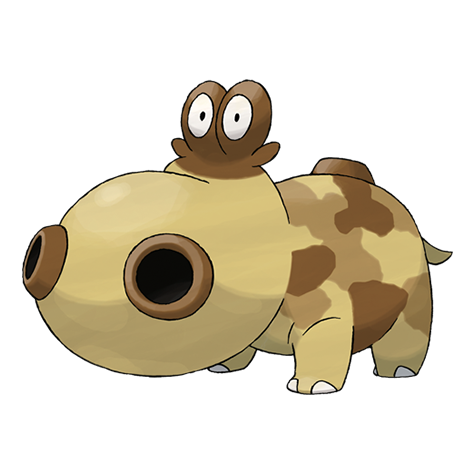

How is visual size determined?
Pokédex height is treated as the official listed measurement, but the chart uses pose-aware visual scaling so each sprite looks reasonable in a direct comparison.
For long or coiled Pokémon, the listed height may represent total body length rather than upright height. For Pokémon with floppy ears, leaves, feathers, antennae, wings, or other flexible features, the chart usually measures to the top of the solid, substantial part of the head or body instead of the tallest decorative feature.
The goal is not to replace the official height, but to make the artwork compare naturally at the size it appears to occupy.