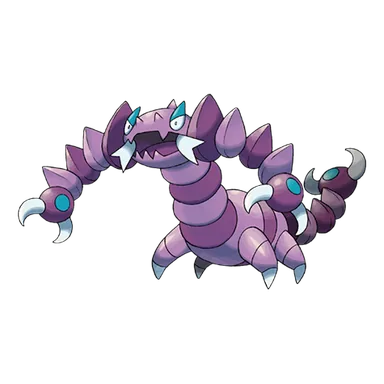
Skorupi is a Poison/Bug-type Pokémon introduced in Generation IV and the first stage of its evolution line, with a base stat total of 330.
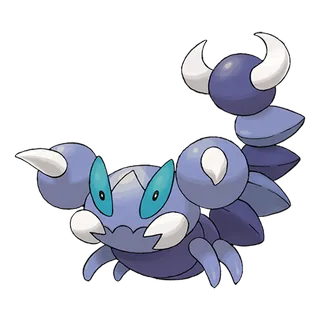
Skorupi


Abilities
Blocks critical hits.
Powers up moves if they become critical hits.
Prevents loss of accuracy.
Hidden AbilityBase Stats
Skorupi's Weaknesses and Resistances





Evolution Chain
Skorupi evolves into Drapion at level 40.
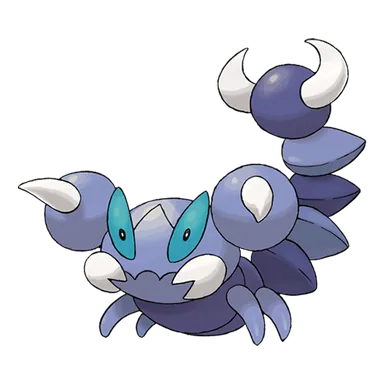 Skorupi
 Drapion

Skorupi Playthrough, Competitive, and Nuzlocke Usage
Using Skorupi in a Playthrough
Skorupi remains Bug/Poison until the relatively late level 40, when it evolves into Drapion and changes to Poison/Dark; that type change is the line's major gameplay payoff because Drapion has only a Ground weakness and gains a complete Psychic immunity. Base 110 Defense, 95 Speed, and 90 Attack make Drapion much sturdier and faster than many defensive Poison-types, while Crunch or Night Slash, Poison Jab, Earthquake, elemental fangs, Aqua Tail in applicable games, Swords Dance, Taunt, and Toxic Spikes give it both offensive and support routes. Battle Armor is exceptionally useful because it prevents critical hits entirely, making physical damage far more predictable, while Sniper rewards critical-hit strategies and the later Hidden Ability Keen Eye prevents accuracy reduction and, in modern mechanics, ignores opposing evasion boosts. The level-40 evolution is somewhat late for a non-pseudo-legendary family, but Skorupi's own physical Defense is respectable enough that careful players can usually train it safely until the dramatic typing and stat improvement arrives. Jolly is a useful nature for offensive Drapion because base 95 Speed is worth preserving, while Impish or Careful can reinforce a more defensive role.
Skorupi in Competitive Pokémon
Drapion was a strong and versatile DPP UU Pokemon whose Poison/Dark typing, single Ground weakness, base 110 Defense, and base 95 Speed supported several very different roles. Swords Dance sets used Crunch with Earthquake and additional coverage to sweep once bulky Ground-types had been weakened, while Pursuit sets trapped important Psychic- and Ghost-types and defensive variants used Toxic Spikes, Taunt, Whirlwind, Knock Off, or RestTalk to exploit Drapion's resistances. It remained a major threat in BW RU, where Swords Dance plus Taunt made it an effective stallbreaker and Pursuit allowed it to punish Pokemon such as Rotom, Slowking, and Cryogonal attempting to switch. Sniper also supported high-critical-hit strategies in later generations, but those sets have generally been less consistent than straightforward Swords Dance or utility approaches because they depend on critical-hit mechanics and item support. Drapion has never become a sustained OU staple because base 90 Attack is merely good without setup and bulky Ground-types remain difficult opponents, but it has a substantial lower-tier competitive history as a sweeper, trapper, Toxic Spikes user, and unusually durable Dark-type.
Skorupi in Nuzlockes
Drapion is exceptionally attractive for Nuzlockes because Poison/Dark has only one conventional weakness, provides a Psychic immunity, and combines well with base 110 Defense and respectable base 70 HP. Battle Armor is arguably the safest ability the line can receive: critical hits are completely impossible, eliminating one of the largest sources of unexpected deaths and making damage calculations far more dependable during long fights. The main danger is Ground coverage, especially Earthquake from strong physical attackers, and the relatively late level-40 evolution means Skorupi must survive a long developmental period before receiving Drapion's superior typing and stats. Swords Dance can shorten battles but exposes Drapion for a setup turn, whereas Taunt, Toxic Spikes, Crunch, and reliable coverage can contribute without relying on risky boosting; Sniper can produce excellent damage but is inherently less predictable than Battle Armor. For a permadeath run, a Battle Armor Drapion used as a Psychic switch-in and physically bulky attacker has an unusually high margin for error as long as Ground moves are identified in advance.
Learnsets
7 moves · Legends Arceus
Level Up — Legends Arceus




Pokédex Entries
8 entries
It grips prey with its tail claws and injects poison. It tenaciously hangs on until the poison takes.
It lives in arid lands. It buries itself in sand and lies in wait for unsuspecting prey.
As soon as the tail claws close, its needle tips secrete poison. It can survive a year without food.
It burrows under the sand to lie in wait for prey. Its tail claws can inject its prey with a savage poison.
It lives in arid regions and can go without food for a year while waiting for prey.
After burrowing into the sand, it waits patiently for prey to come near. This Pokémon and Sizzlipede share common descent.
It attacks using the claws on its tail. Once locked in its grip, its prey is unable to move as this Pokémon’s poison seeps in.
Its claws are not only razor-sharp but poisonous, making Skorupi a highly dangerous Pokémon. It seems to be weakened by cold temperatures, however.
Where To Find Skorupi
6 locations
Route 14 · KalosHorde, Walking · version details vary
Road 14
Route 15 · KalosRed Flowers, Walking · version details vary
Road 15
Route 16 · KalosYellow Flowers · version details vary
Road 16
Great Marsh · SinnohWalking · version details vary
Great Marsh Area 1
Great Marsh Area 2
Great Marsh Area 3
Great Marsh Area 4
Great Marsh Area 5
Great Marsh Area 6
Reversal Mountain · UnovaDark Grass, Walking · version details vary
Reversal Mountain (unknown area 48)
Reversal Mountain (unknown area 49)
Reversal Mountain (unknown area 50)
Reversal Mountain (unknown area 51)
Reversal Mountain (unknown area 52)
Reversal Mountain (unknown area 53)
Reversal Mountain (unknown area 54)
Reversal Mountain (unknown area 55)
Reversal Mountain (unknown area 56)
Reversal Mountain (unknown area 57)
Reversal Mountain (unknown area 58)
Reversal Mountain (unknown area 59)
Reversal Mountain (unknown area 60)
Route 13 · UnovaHidden Grotto · version details vary
Unova Route 13 (Hidden Grotto – Giant Chasm)
Held Items
1 items
- Diamond: 5% chance
- Pearl: 5% chance
- Platinum: 5% chance
- Heartgold: 5% chance
- Soulsilver: 5% chance
- Black: 5% chance
- White: 5% chance
- Black 2: 5% chance
- White 2: 5% chance
- X: 5% chance
- Y: 5% chance
- Omega Ruby: 5% chance
- Alpha Sapphire: 5% chance
- Sun: 5% chance
- Moon: 5% chance
- Ultra Sun: 5% chance
- Ultra Moon: 5% chance
Additional Images
PokeAPI sprites
Open this section to load extra PokeAPI sprite images.
Skorupi Biology and Behavior
Skorupi is an ambush predator that buries itself beneath sand and waits almost motionless for prey to pass nearby. Its anatomy reverses the familiar scorpion arrangement: the tail ends in a gripping claw, while the two forelimbs carry venomous stingers, allowing Skorupi to seize a victim with the tail and inject poison before holding on until the toxin takes effect. It is extraordinarily resistant to starvation and can survive for an entire year without eating. Although strongly associated with deserts and other dry regions, Skorupi also inhabits marshland such as Sinnoh's Great Marsh. Modern biological material additionally identifies Skorupi and Sizzlipede as descendants of a common ancestor, placing the species within a broader evolutionary history of venomous arthropod Pokemon.
Skorupi Biological Data
- National Pokédex
- #451
- Species
- Scorpion Pokémon
- Height
- 2' 7" (0.8 m)
- Weight
- 26.5 lbs (12.0 kg)
- Habitat
- Currently Unknown
- Color
- Purple
- Body Style
- Armor
- Gender
- 50% female / 50% male
Misc
Catch Rate: 120
Base Experience: 66 Exp
Hatch Counter: 20
Skorupi Size Comparison: BETA
Skorupi is listed at 2' 7" (0.8 m) and shown in an in-chart visual comparison.
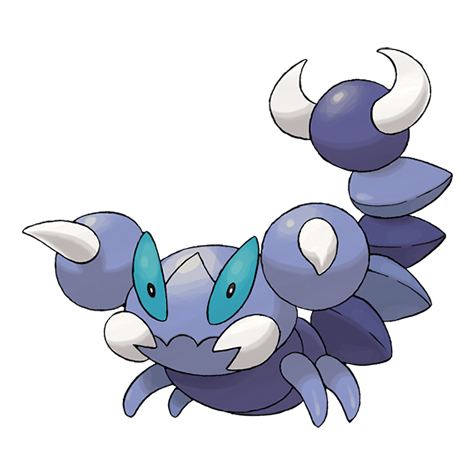

How is visual size determined?
Pokédex height is treated as the official listed measurement, but the chart uses pose-aware visual scaling so each sprite looks reasonable in a direct comparison.
For long or coiled Pokémon, the listed height may represent total body length rather than upright height. For Pokémon with floppy ears, leaves, feathers, antennae, wings, or other flexible features, the chart usually measures to the top of the solid, substantial part of the head or body instead of the tallest decorative feature.
The goal is not to replace the official height, but to make the artwork compare naturally at the size it appears to occupy.