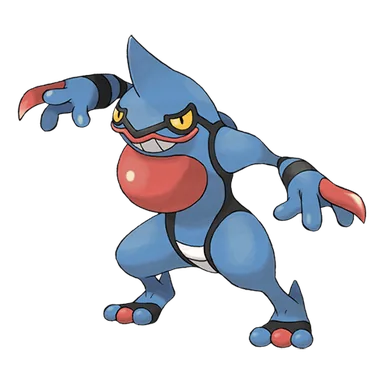
Croagunk is a Poison/Fighting-type Pokémon introduced in Generation IV and the first stage of its evolution line, with a base stat total of 300.
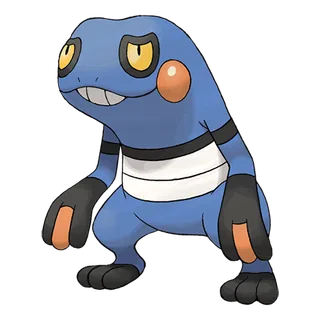
Croagunk


Abilities
Senses the foe’s dangerous moves.
Reduces HP if it is hot. Water restores HP.
May poison targets when a Pokémon makes contact.
Hidden AbilityBase Stats
Croagunk's Weaknesses and Resistances





Evolution Chain
Croagunk evolves into Toxicroak at level 37.
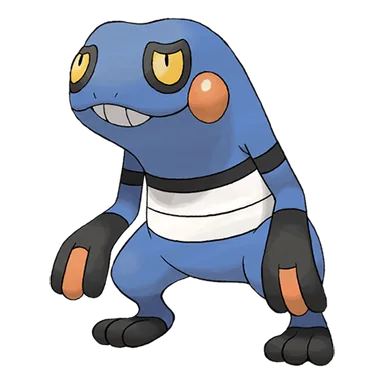 Croagunk
 Toxicroak
Croagunk Playthrough, Competitive, and Nuzlocke Usage
Using Croagunk in a Playthrough
Croagunk evolves into Toxicroak at level 37, producing a Poison/Fighting physical attacker with base 106 Attack, usable base 85 Speed, and broad offensive options including Drain Punch or Close Combat, Poison Jab or Gunk Shot, Sucker Punch, Knock Off, Ice Punch, and setup through Swords Dance or Bulk Up. The typing grants useful resistances to Fighting, Grass, Poison, Rock, Dark, and especially Bug, but Psychic attacks deal quadruple damage and Flying and Ground are also super effective, while only 65 in both defenses limits how safely Toxicroak can take neutral hits. Dry Skin is the family's defining ability: Water attacks heal rather than damage Toxicroak and rain provides passive recovery, but Fire attacks deal extra damage and harsh sunlight steadily hurts it; Anticipation instead warns when an opponent carries a super-effective or one-hit-knockout move, which can be excellent information in a story run. The later Hidden Ability Poison Touch adds a chance to poison targets hit by contact moves but lacks the defensive utility of Dry Skin or the scouting value of Anticipation. Jolly is particularly useful because base 85 Speed sits in a crowded range, while Adamant maximizes the line's physical pressure; Drain Punch is generally easier to use safely than defense-lowering Close Combat or inaccurate Gunk Shot during an ordinary playthrough.
Croagunk in Competitive Pokémon
Toxicroak debuted as a useful DPP UU attacker and also possessed legitimate doubles utility through Fake Out, Taunt, priority Sucker Punch, and Dry Skin, but Generation V rain mechanics produced its most famous competitive period. In BW OU, permanent rain from Politoed gave Dry Skin Toxicroak passive recovery every turn while Water attacks healed it completely instead of damaging it, allowing it to set up on many bulky Water-types and become both a beneficiary of rain teams and a strong weapon against opposing rain. Bulk Up sets combined Substitute, Drain Punch, and Sucker Punch for remarkable staying power, while Swords Dance variants traded some durability for immediate sweeping pressure and used coverage such as Ice Punch to target common checks. Toxicroak later became an important XY UU Pokemon and has continued to appear in lower tiers as a Swords Dance wallbreaker, priority user, and Water-type switch-in, with modern Smogon analyses still identifying Dry Skin as the trait that separates it from competing Fighting-types. Its enduring problems are mediocre 83/65/65 bulk, only base 85 Speed, a quadruple Psychic weakness, and competition from stronger Fighting attackers, so its best competitive eras have depended heavily on how valuable its unusual typing and Water immunity are in the surrounding metagame.
Croagunk in Nuzlockes
Toxicroak can be excellent in a Nuzlocke when its ability and matchup are known, but its defensive profile contains both unusually safe switches and unusually dangerous failure points. Dry Skin creates a complete Water immunity with healing and can provide passive recovery in rain, while Anticipation can reveal the presence of super-effective or one-hit-knockout moves before the player commits to a risky exchange; both abilities offer more predictable safety than Poison Touch. The quadruple Psychic weakness is the critical danger, and strong Ground or Flying moves can also overwhelm the line's mediocre defenses, so an unexpected coverage move may be lethal even from an otherwise favorable opponent. Drain Punch is exceptionally Nuzlocke-friendly because it combines reliable Fighting damage with healing, while Sucker Punch can finish faster threats but fails if the opponent does not attack and therefore should not be treated as guaranteed priority. Deliberately exploiting Dry Skin in rain is generally safer than competitive Substitute or Life Orb strategies, and Jolly can reduce the number of opponents able to hit first without requiring Toxicroak to accept extra recoil or defensive drops.
Learnsets
79 moves · Scarlet Violet
Level Up





Machine




Egg

Pokédex Entries
9 entries
Its cheeks hold poison sacs. It tries to catch foes off guard to jab them with toxic fingers.
Inflating its poison sacs, it makes an eerie blubbering sound for intimidation.
It rarely fights fairly, but that is strictly to ensure survival. It is popular as a mascot.
Fluid squeezed from its finger, albeit poisonous, is a significant ingredient in remedies for lower-back pain.
Fluid squeezed from its finger, albeit poisonous, is a significant ingredient in remedies for lower back pain.
Inflating its poison sacs, it fills the area with an odd sound and hits flinching opponents with a poison jab.
It makes frightening noises with its poison-filled cheek sacs. When opponents flinch, Croagunk hits them with a poison jab.
Once diluted, its poison becomes medicinal. This Pokémon came into popularity after a pharmaceutical company chose it as a mascot.
A poison wielder with a dastardly personality. Despite such qualities, this species is afforded a measure of popularity due to its peculiar cry and comical features.
Where To Find Croagunk
8 locations
Galar Mine No. 2 · GalarOverworld · version details vary
Galar Mine No. 2
Motostoke Outskirts · GalarWalking · version details vary
Motostoke Outskirts
Route 7 · KalosPurple Flowers, Walking, Yellow Flowers · version details vary
Road 7
Great Marsh · SinnohWalking · version details vary
Great Marsh Area 1
Great Marsh Area 2
Great Marsh Area 3
Great Marsh Area 4
Great Marsh Area 5
Great Marsh Area 6
Route 212 · SinnohWalking · version details vary
Road 212 (east, towards Pastoria City)
Icirrus City · UnovaWalking · version details vary
Icirrus City
Moor of Icirrus · UnovaWalking · version details vary
Moor of Icirrus
Route 8 · UnovaWalking · version details vary
Road 8
Held Items
1 items
- Diamond: 5% chance
- Pearl: 5% chance
- Platinum: 5% chance
- Heartgold: 5% chance
- Soulsilver: 5% chance
- Black: 5% chance
- White: 5% chance
- Black 2: 5% chance
- White 2: 5% chance
- X: 5% chance
- Y: 5% chance
- Omega Ruby: 5% chance
- Alpha Sapphire: 5% chance
- Sun: 5% chance
- Moon: 5% chance
- Ultra Sun: 5% chance
- Ultra Moon: 5% chance
Additional Images
PokeAPI sprites
Open this section to load extra PokeAPI sprite images.
Croagunk Biology and Behavior
Croagunk stores poisonous fluid in expandable cheek pouches and in the fingers of its hands, using the cheek sacs to create an unnerving sound that distracts an opponent before it attempts to stab with a venomous finger. Despite this sinister hunting method, Pokédex material says Croagunk generally fights only when necessary for survival rather than attacking indiscriminately. Its toxin has an important medical use: once properly diluted, fluid extracted from the fingers becomes a valued ingredient in remedies for lower-back pain, and the species has even served as the mascot of a pharmaceutical company. Croagunk normally inhabits swamps and forested wetlands and is related evolutionarily to the Seismitoad family. During sleep it may unconsciously inflate its cheek sacs, sometimes startling itself awake with the resulting sound.
Croagunk Biological Data
- National Pokédex
- #453
- Species
- Toxic Mouth Pokémon
- Height
- 2' 4" (0.7 m)
- Weight
- 50.7 lbs (23.0 kg)
- Habitat
- Currently Unknown
- Color
- Blue
- Body Style
- Humanoid
- Gender
- 50% female / 50% male
Misc
Catch Rate: 140
Base Experience: 60 Exp
Hatch Counter: 10
Croagunk Size Comparison: BETA
Croagunk is listed at 2' 4" (0.7 m) and shown in an in-chart visual comparison.
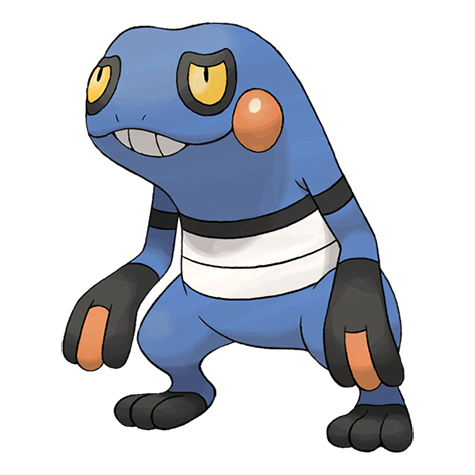

How is visual size determined?
Pokédex height is treated as the official listed measurement, but the chart uses pose-aware visual scaling so each sprite looks reasonable in a direct comparison.
For long or coiled Pokémon, the listed height may represent total body length rather than upright height. For Pokémon with floppy ears, leaves, feathers, antennae, wings, or other flexible features, the chart usually measures to the top of the solid, substantial part of the head or body instead of the tallest decorative feature.
The goal is not to replace the official height, but to make the artwork compare naturally at the size it appears to occupy.