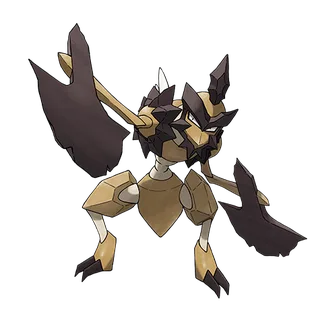
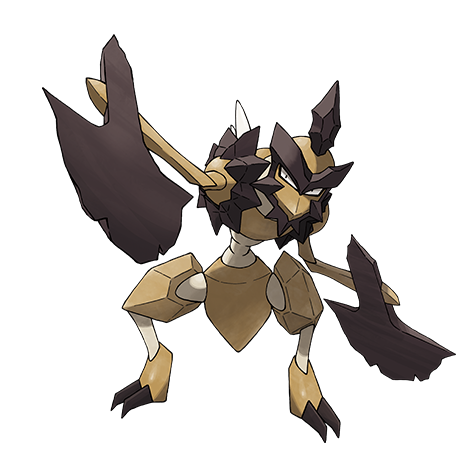
Kleavor is a Bug/Rock-type Pokémon introduced in Generation VIII and a final stage of its evolution line, with a base stat total of 500.
Kleavor


Abilities
Ups BUG moves in a pinch.
Removes added effects to increase move damage.
Powers up slicing moves.
Hidden AbilityBase Stats
Kleavor's Weaknesses and Resistances




Evolution Chain
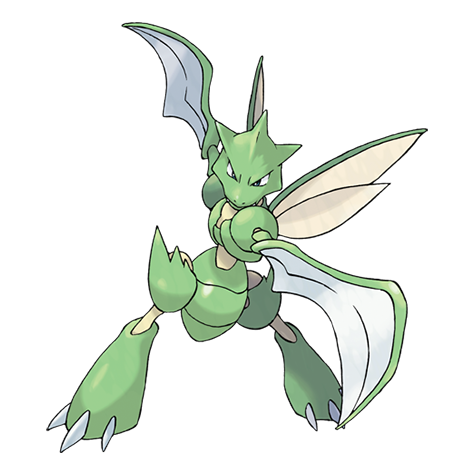
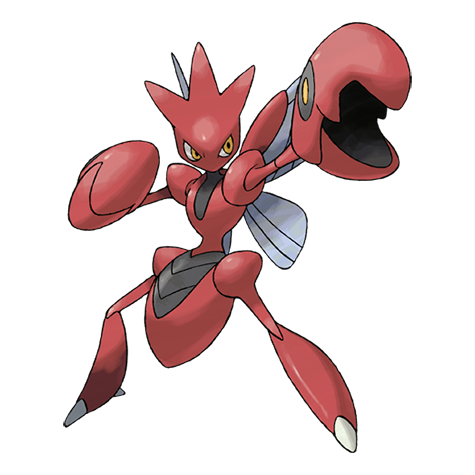
Scyther can evolve into Scizor by trading while holding a Metal Coat or with a Metal Coat or Kleavor with a Black Augurite.
 Scyther

 Scizor
 Kleavor
 Playthrough, Competitive, and Nuzlocke Usage
Using Kleavor in a Playthrough
Scyther begins as a fast physical Bug/Flying attacker with excellent Attack and Speed but a severe quadruple Rock weakness. Trading Scyther while holding a Metal Coat produces Scizor, which trades Speed for much greater defensive utility through Bug/Steel typing, strong Attack, and Technician-boosted priority such as Bullet Punch; using Black Augurite in games where it is available instead produces Kleavor, a Bug/Rock attacker with still higher Attack and access to Stone Axe. Because Scizor is a trade evolution and Kleavor's item is game-specific, many playthroughs use Scyther itself, which remains statistically strong despite being unevolved. The branches serve different needs: Scizor is the safest and most balanced, while Kleavor favors immediate physical pressure.
Kleavor in Competitive Pokémon
Scizor has had an exceptional competitive career built around Technician Bullet Punch, U-turn, Swords Dance, and its excellent Bug/Steel defensive typing. Priority compensates for its low Speed and lets it revenge kill weakened opponents, while Mega Scizor adds still greater bulk and setup potential. Kleavor has a different niche through high Attack, Sharpness, and Stone Axe, which simultaneously damages the target and establishes Stealth Rock. Scyther itself can remain viable in lower tiers through high Speed, Eviolite in later generations, and Technician, although its quadruple weakness to Stealth Rock is a major limitation.
Kleavor in Nuzlockes
Scyther is immediately strong but risky around Rock coverage, while Scizor is one of the safest possible outcomes of the line because Steel typing supplies numerous resistances and Technician Bullet Punch gives reliable priority. The problem is accessibility: Scizor normally requires a trade with Metal Coat, and Kleavor requires a game that provides Black Augurite or another supported evolution method. Kanto Scyther is also a Safari Zone encounter, reducing encounter reliability. When an evolved branch is available, Scizor usually favors risk control while Kleavor favors fast offensive progress.
Learnsets
61 moves · Scarlet Violet
Level Up



Machine





Pokédex Entries
1 entries
A violent creature that fells towering trees with its crude axes and shields itself with hard stone. If one should chance upon this Pokémon in the wilds, one's only recourse is to flee.
Additional Images
PokeAPI sprites
Open this section to load extra PokeAPI sprite images.
Kleavor Biology and Behavior
Kleavor has a rugged mineral exoskeleton and large stone axes formed from the same material. It uses the axes to chop trees, mark territory, and dispatch prey, leaving characteristic cutting scars throughout its habitat. Its wings are reduced compared with Scyther, and its biology reflects adaptation toward a heavy terrestrial Rock-type body rather than aerial movement.
Kleavor Biological Data
- National Pokédex
- #900
- Species
- Axe Pokémon
- Height
- 5' 11" (1.8 m)
- Weight
- 196.2 lbs (89.0 kg)
- Habitat
- Currently Unknown
- Color
- Brown
- Body Style
- Bug Wings
- Gender
- 50% female / 50% male
Misc
Catch Rate: 115
Base Experience: 175 Exp
Hatch Counter: 20
Kleavor Size Comparison: BETA
Kleavor is listed at 5' 11" (1.8 m) and shown in an in-chart visual comparison.

How is visual size determined?
Pokédex height is treated as the official listed measurement, but the chart uses pose-aware visual scaling so each sprite looks reasonable in a direct comparison.
For long or coiled Pokémon, the listed height may represent total body length rather than upright height. For Pokémon with floppy ears, leaves, feathers, antennae, wings, or other flexible features, the chart usually measures to the top of the solid, substantial part of the head or body instead of the tallest decorative feature.
The goal is not to replace the official height, but to make the artwork compare naturally at the size it appears to occupy.