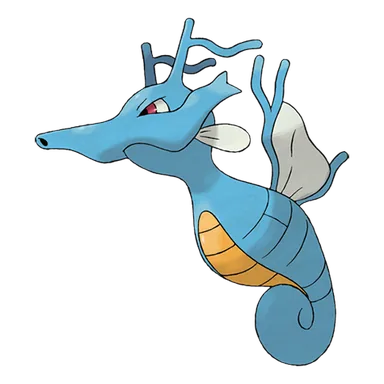
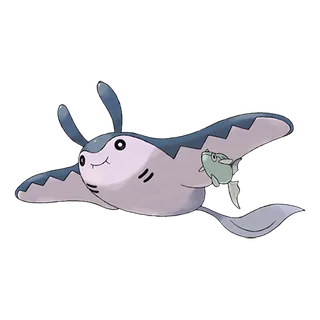
Mantine is a Water/Flying-type Pokémon introduced in Generation II and a final stage of its evolution line, with a base stat total of 485.
Mantine


Abilities
Raises SPEED in rain.
Changes water into HP.
Prevents burns.
Hidden AbilityBase Stats
Mantine's Weaknesses and Resistances







Evolution Chain
Mantyke evolves into Mantine by leveling up with Remoraid in party.
 Mantyke
 Mantine
 Playthrough, Competitive, and Nuzlocke Usage
Using Mantine in a Playthrough
The Mantyke line develops into Mantine, a Water/Flying Pokemon built primarily around enormous Special Defense rather than conventional offensive power. Mantyke evolves when it levels up while a Remoraid is present in the party, an unusual requirement that can make evolution dependent on catching a second specific Pokemon; games released before Generation IV simply provide Mantine directly because Mantyke did not yet exist. Mantine's base 140 Special Defense is exceptional, and beginning in Generation VII its base HP was increased to 85, giving it substantially better overall special bulk than in earlier generations. Water/Flying typing supplies a Ground immunity and useful resistances to Fire, Water, Fighting, Bug, and Steel, while Water Absorb can add a complete Water immunity; Surf or Scald, Air Slash, Ice Beam, Roost, Haze, and Defog or other support moves can give it both offensive and defensive utility depending on the game. The major dangers are low physical Defense, a Rock weakness, and especially a quadruple Electric weakness, making Mantine excellent against selected special attackers but extremely unsafe around unknown Electric coverage.
Mantine in Competitive Pokémon
Mantine's competitive identity is that of a specialized special wall and utility Pokemon whose base 140 Special Defense lets it absorb attacks that would overwhelm many other Water-types. Water Absorb can turn opposing Water attacks into free healing, while Scald, Roost, Toxic, Haze, and especially Defog in relevant generations let Mantine combine defensive checking with hazard removal and anti-setup utility. Its Generation VII HP increase from 65 to 85 made this role substantially stronger, and Smogon analyses from that era highlight its ability to repeatedly switch into powerful special attackers and use those turns to clear hazards or spread status. The limitations are severe but easy to identify: a quadruple Electric weakness, susceptibility to Stealth Rock, mediocre physical Defense, and relatively passive damage output mean opponents can exploit it with the right coverage or physical wallbreakers. Mantine therefore succeeds as a role-specific special sponge rather than as a universal defensive Water-type.
Mantine in Nuzlockes
Mantine can be an excellent Nuzlocke specialist because enormous Special Defense and numerous useful resistances make selected special attackers extraordinarily safe to fight. Water Absorb is especially valuable when available, turning predictable Water attacks into healing opportunities, while the Ground immunity adds another source of completely safe switches. The line's danger is concentrated in a few very important places: Electric attacks deal quadruple damage, Rock attacks are super effective, and Mantine's physical Defense is much lower than its special bulk, so strong neutral physical hits can be more dangerous than its overall durability initially suggests. Mantyke itself already has excellent Special Defense but poor offenses and physical durability, and the requirement to keep a Remoraid in the party while leveling can delay evolution if that species has not yet been caught. Once evolved, Mantine is one of the safer answers to known special Water-, Fire-, Ice-, and other favorable attackers, provided the player treats Electric coverage as potentially lethal.
Learnsets
8 moves · Legends Arceus
Level Up — Legends Arceus




Pokédex Entries
18 entries
As it majestically swims, it doesn't care if REMORAID attach to it for scavenging its leftovers.
Swimming freely in open seas, it may fly out of the water and over the waves if it builds up enough speed.
It swims along freely, eating things that swim into its mouth. Its whole body is very coarse.
On sunny days, schools of MANTINE can be seen elegantly leaping over the sea’s waves. This POKéMON is not bothered by the REMORAID that hitches rides.
On sunny days, schools of MANTINE can be seen elegantly leaping over the waves. It is not bothered by the REMORAID that hitches rides.
As it majestically swims, it doesn’t care if REMORAID attach to it to scavenge for its leftovers.
When the waves are calm, one may encounter a swarm of MANTINE swimming as if they are in flight.
It swims elegantly, mindless of REMORAID hitching on to its broad fins. It has a docile nature.
While elegantly swimming in the sea, it ignores REMORAID that cling to its fins seeking food scraps.
As it majestically swims, it doesn’t care if REMORAID attach to it for scavenging its leftovers.
While elegantly swimming in the sea, it ignores Remoraid that cling to its fins seeking food scraps.
If it builds up enough speed swimming, it can fly over 300 feet out of the water from the surface of the ocean.
On sunny days, schools of Mantine can be seen elegantly leaping over the sea’s waves. This Pokémon is not bothered by the Remoraid that hitches rides.
Postcards and posters featuring Mantine leaping elegantly above the waves are popular souvenirs of Alola.
Many people have taken up surfing because they admire how magnificently Mantine swims.
If it builds up enough speed swimming, it can jump out above the waves and glide for over 300 feet.
As it majestically swims, it doesn’t care if Remoraid attach to it to scavenge for its leftovers.
This calm and gentle Pokémon swims gracefully through the sea. After building speed, it can leap out of the water. It is often misidentified as a bird Pokémon due to this behavior.
Where To Find Mantine
8 locations
Sea Route 41 · JohtoSurf · version details vary
Road 41
Tanoby Ruins · KantoSurf · version details vary
Tanoby Ruins
Trainer Tower · KantoSurf · version details vary
Trainer Tower
Pyrite Bldg · OrreSnag · version details vary
Pyrite Bldg 4F
Pyrite Cave · OrreSnag Rematch · version details vary
Pyrite Cave (Miror's Hideout)
Route 21 · UnovaSurf Spots · version details vary
Road 21
Undella Bay · UnovaSurf Spots · version details vary
Undella Bay
Undella Town · UnovaSurf Spots · version details vary
Undella Town
Additional Images
PokeAPI sprites
Open this section to load extra PokeAPI sprite images.
Mantine Biology and Behavior
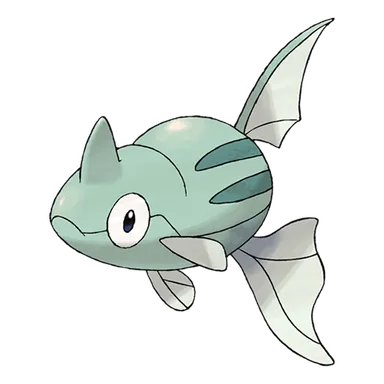
Mantine is a large, docile open-ocean Pokemon that swims in schools and can build enough speed beneath the surface to leap roughly 300 feet, or 100 meters, into the air. Early observers sometimes mistook these enormous breaches for the flight of a bird Pokemon, illustrating how dramatically the species can leave its normal aquatic environment. Remoraid commonly attach beneath Mantine's fins using suction, feeding on scraps left behind by the larger Pokemon and helping defend it when attacked; Mantine appears entirely comfortable with this relationship. In Alola, humans ride Mantine between islands and surf waves on their backs, making the species an important part of recreation, transportation, and regional popular culture. Its combination of social schooling, tolerance of Remoraid, and calm interactions with humans makes Mantine one of the more conspicuously cooperative large marine Pokemon.
Mantine Biological Data
- National Pokédex
- #226
- Species
- Kite Pokémon
- Height
- 6' 11" (2.1 m)
- Weight
- 485.0 lbs (220.0 kg)
- Habitat
- Sea
- Color
- Purple
- Body Style
- Wings
- Gender
- 50% female / 50% male
Misc
Catch Rate: 25
Base Experience: 170 Exp
Hatch Counter: 25
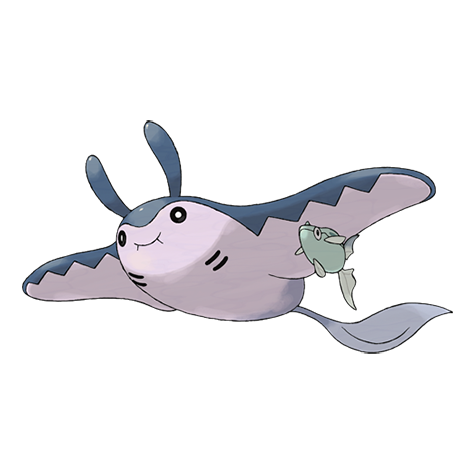
Mantine Size Comparison: BETA
Mantine is listed at 6' 11" (2.1 m); this chart uses a pose-adjusted visual scale.

How is visual size determined?
Pokédex height is treated as the official listed measurement, but the chart uses pose-aware visual scaling so each sprite looks reasonable in a direct comparison.
For long or coiled Pokémon, the listed height may represent total body length rather than upright height. For Pokémon with floppy ears, leaves, feathers, antennae, wings, or other flexible features, the chart usually measures to the top of the solid, substantial part of the head or body instead of the tallest decorative feature.
The goal is not to replace the official height, but to make the artwork compare naturally at the size it appears to occupy.
Mantine currently uses a pose-adjusted visual scale.