Torterra is a Grass/Ground-type Pokémon introduced in Generation IV and a final stage of its evolution line, with a base stat total of 525.
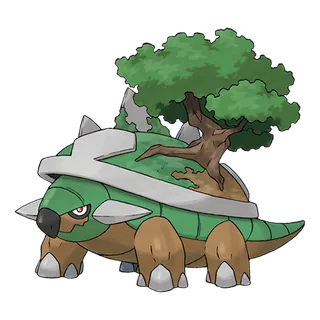
Torterra


Abilities
Ups GRASS moves in a pinch.
Blocks critical hits.
Hidden AbilityBase Stats
Torterra's Weaknesses and Resistances



Evolution Chain
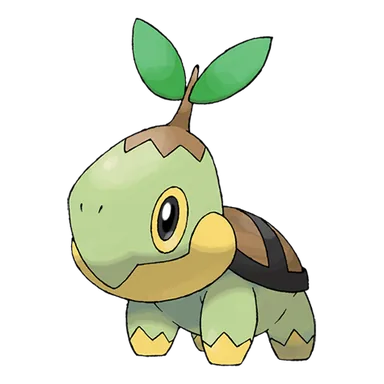
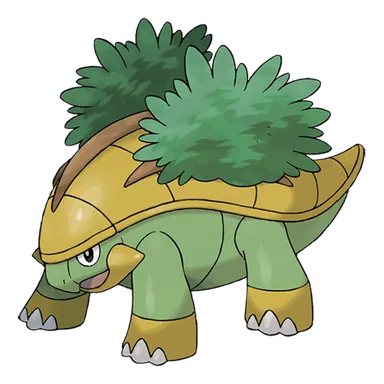
Turtwig evolves into Grotle at level 18, and Grotle evolves into Torterra at level 32.
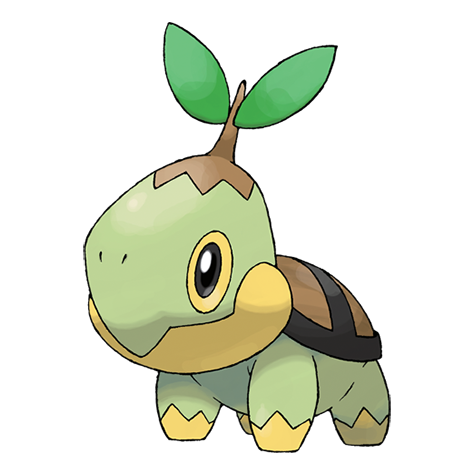 Turtwig
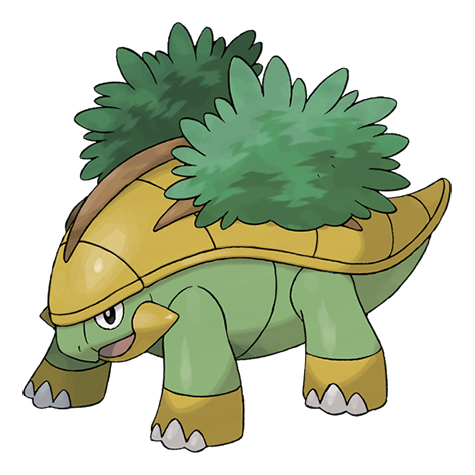 Grotle
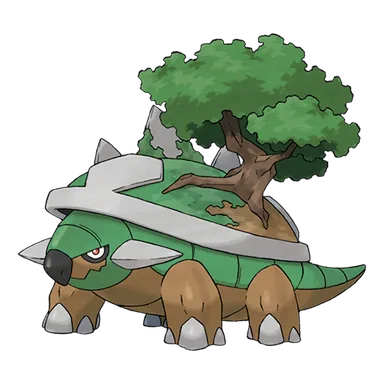 Torterra
 Playthrough, Competitive, and Nuzlocke Usage
Using Torterra in a Playthrough
The Turtwig line is a slow, physically sturdy starter family that reaches Grotle at level 18 and Torterra at level 32, giving it an earlier final evolution than many three-stage starters. Torterra's base 109 Attack, 105 Defense, and 95 HP make it an effective physical tank and attacker, while Grass/Ground typing provides STAB on moves such as Wood Hammer, Seed Bomb, Razor Leaf, and Earthquake plus a complete Electric immunity. In the Sinnoh games, the line performs especially well into Rock-, Ground-, and many Water-type opponents, although its low Speed means it often has to absorb a hit before attacking and its quadruple Ice weakness can turn otherwise favorable-looking matchups into sudden losses. Overgrow is the normal ability, while the later Hidden Ability Shell Armor prevents critical hits and is especially valuable on a bulky Pokemon that expects to take repeated attacks. Modern Torterra is substantially more explosive than its original version because Generation IX gave it Shell Smash, allowing it to double its Attack and Speed at the cost of lowering both defenses; Adamant is a straightforward nature for ordinary physical sets, while more defensive builds can reasonably favor Impish or Careful instead.
Torterra in Competitive Pokémon
Torterra was a genuine DPP UU threat rather than merely a usable starter, with Rock Polish sets exploiting its strong dual STAB to sweep after fixing its poor base 56 Speed and Choice Band sets using Wood Hammer and Earthquake to break common physical walls. Its 95/105 physical bulk also supported defensive variants, while Stone Edge, Superpower, and status or phazing options prevented it from being completely one-dimensional. The recurring problem has always been defensive typing: a quadruple Ice weakness, additional Fire, Flying, and Bug weaknesses, and low natural Speed give offensive teams several reliable ways to force it out or revenge kill it. Power creep pushed Torterra down the tiering ladder in later generations, but Generation IX gave it a major revival through Shell Smash, and Smogon currently lists it in SV RU as a dangerous setup sweeper. Shell Smash does not erase its flaws—priority Ice moves and faster Choice Scarf users can still stop it—but the move finally turns Torterra's high Attack and strong STAB combination into an immediate sweeping threat instead of forcing it to rely mainly on Rock Polish or wallbreaking.
Torterra in Nuzlockes
The Turtwig line is generally strong in Nuzlockes because it evolves at reasonable levels, has excellent physical bulk, and gains a useful Electric immunity once it becomes Torterra. Its biggest danger is the quadruple Ice weakness: Ice Beam, Ice Fang, Ice Punch, and especially priority Ice Shard can be lethal even when Torterra appears healthy, so blind switching is much riskier than its bulk suggests. Low Speed also increases exposure to critical hits and secondary effects because the line often moves second; where the Hidden Ability is legitimately available, Shell Armor removes the critical-hit risk entirely and is one of the safest abilities a bulky Nuzlocke Pokemon can have. Wood Hammer's recoil is powerful but undesirable in permadeath play when Seed Bomb or another safer Grass move can secure the same knockout, and Shell Smash is similarly high-risk because it deliberately lowers both defenses. Torterra is therefore safest as a durable physical attacker that uses known resistances and Earthquake's reliability rather than repeatedly gambling on recoil or defense-lowering setup.
Learnsets
84 moves · Scarlet Violet
Level Up







Machine



Egg
Pokédex Entries
7 entries
Small Pokémon occasionally gather on its unmoving back to begin building their nests.
Groups of this Pokémon migrating in search of water have been mistaken for “moving forests.”
Some Pokémon are born on a TORTERRA’s back and spend their entire life there.
Ancient people imagined that beneath the ground, a gigantic TORTERRA dwelled.
Some Pokémon are born on a Torterra’s back and spend their entire life there.
Ancient people imagined that beneath the ground, a gigantic Torterra dwelled.
This remarkable, large-bodied Pokémon would serve beautifully as borrowed scenery for a garden, and its strength is peerless. Torterra roams the wilderness in search of clean water.
Additional Images
PokeAPI sprites
Open this section to load extra PokeAPI sprite images.
Torterra Biology and Behavior
Torterra carries a functioning miniature ecosystem on its enormous shell: soil, stone, and a large tree provide habitat where small Pokemon can gather, build nests, and in some cases be born and spend their entire lives. Groups of Torterra migrate in search of clean water, and from a distance these slow-moving herds have been mistaken for forests moving across the landscape. Despite this migratory behavior, individual Torterra are often almost completely motionless for long periods, allowing other species to treat the shell as stable terrain. Ancient people imagined that the ground itself rested above a gigantic Torterra, showing how the species' continent-like body entered human cosmology as well as ecology. Its relationship with smaller Pokemon is therefore unusually literal: Torterra is not merely part of an ecosystem but can physically serve as the ecosystem's ground, vegetation, and nesting site.
Torterra Biological Data
- National Pokédex
- #389
- Species
- Continent Pokémon
- Height
- 7' 3" (2.2 m)
- Weight
- 683.4 lbs (310.0 kg)
- Habitat
- Currently Unknown
- Color
- Green
- Body Style
- Quadruped
- Gender
- 12.5% female / 87.5% male
Misc
Catch Rate: 45
Base Experience: 236 Exp
Hatch Counter: 20
Torterra Size Comparison: BETA
Torterra is listed at 7' 3" (2.2 m); this chart uses a pose-adjusted visual scale because leaves or foliage can extend beyond the substantial body.
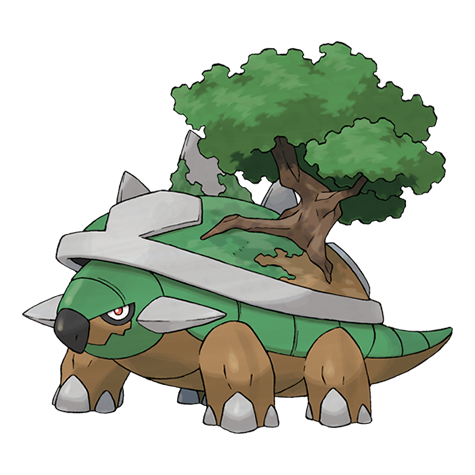

How is visual size determined?
Pokédex height is treated as the official listed measurement, but the chart uses pose-aware visual scaling so each sprite looks reasonable in a direct comparison.
For long or coiled Pokémon, the listed height may represent total body length rather than upright height. For Pokémon with floppy ears, leaves, feathers, antennae, wings, or other flexible features, the chart usually measures to the top of the solid, substantial part of the head or body instead of the tallest decorative feature.
The goal is not to replace the official height, but to make the artwork compare naturally at the size it appears to occupy.
Torterra is currently tagged for leaves/foliage.