Brute Bonnet is a Grass/Dark-type Pokémon introduced in Generation IX, with a base stat total of 570 and no standard evolutions.
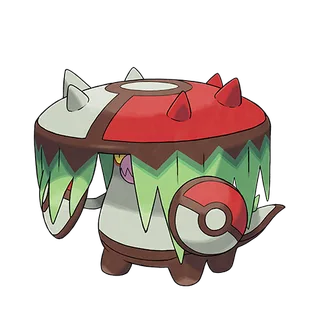
Brute Bonnet


Abilities
Boosts the Pokémon's most proficient stat in harsh sunlight or if the Pokémon is holding Booster Energy.
Base Stats
Brute Bonnet's Weaknesses and Resistances










Evolution Chain
Brute Bonnet does not evolve into or from any other Pokémon.
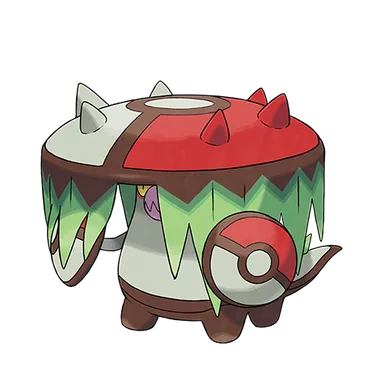 Brute Bonnet
 Playthrough, Competitive, and Nuzlocke Usage
Using Brute Bonnet in a Playthrough
Brute Bonnet is a standalone Grass/Dark Paradox Pokémon available naturally in Scarlet's Area Zero near the end of the main story, while Violet normally requires trade or Union Circle access. Its stat distribution favors slow physical pressure and durability: 111 HP, 127 Attack, 99 Defense, and 99 Special Defense make it difficult to remove with neutral damage, but base 55 Speed means it will often take a hit before acting. Spore is the defining playthrough tool because its perfect base accuracy gives Brute Bonnet a highly reliable way to put susceptible targets to sleep, creating safe turns for attacking, switching, healing, or setting up; Grass-types, Overcoat users, and Safety Goggles still ignore powder moves. Seed Bomb and Crunch provide dependable physical STAB, Sucker Punch compensates for its low Speed with priority, and Close Combat can cover opposing Steel- and Dark-types at the cost of lowering both defenses. Synthesis gives it direct recovery, with the amount depending on weather, while Protosynthesis can further enhance its highest stat in harsh sunlight or through Booster Energy. Its type chart is the major drawback: Grass/Dark has weaknesses to Fire, Ice, Fighting, Flying, Poison, Fairy, and a devastating 4× weakness to Bug, so the high raw bulk does not make it safe against unknown coverage. Adamant is excellent for maximizing its physical pressure, while Impish or Careful can exploit its strong natural bulk when Spore and support are more important than damage.
Brute Bonnet in Competitive Pokémon
Brute Bonnet currently resides in SV ZU, but that usage tier understates the specialized roles it has occupied in both singles and official doubles. In singles it combines base 127 Attack with Spore, Sucker Punch, Crunch, Seed Bomb, and coverage such as Close Combat, allowing it to disable an answer and then apply meaningful physical pressure rather than functioning as a purely passive mushroom. Smogon's PU analysis has treated it as a specialized offensive wallbreaker even while its current usage tier is ZU, illustrating the difference between usage placement and matchup-specific viability. The main obstacles are severe: base 55 Speed forces heavy dependence on Sucker Punch or absorbing a hit, the 4× Bug weakness can be exploited by U-turn, and six additional ordinary weaknesses make defensive positioning far less forgiving than its 111/99/99 bulk initially suggests. Its doubles niche is considerably clearer because Spore and Rage Powder combine disruption with redirection, while Sucker Punch keeps it from becoming totally passive and Pollen Puff can heal an ally; Smogon continued to document this bulky-support role as late as VGC 2025 Regulation I. Sun teams can activate Protosynthesis without consuming Booster Energy, and defensive Terastallization has historically been valuable for removing several of Grass/Dark's dangerous weaknesses. Brute Bonnet never replaced Amoonguss as the universal mushroom support Pokémon, but its stronger physical offense, Dark typing, Sucker Punch, and Protosynthesis created a distinct competitive niche rather than making it simply an ancient reskin.
Brute Bonnet in Nuzlockes
Brute Bonnet can be exceptionally useful in a late-game Scarlet Nuzlocke because 100%-accurate Spore gives the player direct control over many dangerous encounters without depending on a damage roll or an inaccurate sleep move. Its 111/99/99 bulk is genuinely strong and Synthesis provides renewable healing, while Sucker Punch offers priority that compensates for its low base 55 Speed when a weakened attacker must be removed before it moves. The danger is its unusually poor weakness profile: Grass/Dark is weak to Fire, Ice, Fighting, Flying, Poison, and Fairy and takes 4× damage from Bug, so an unexpected U-turn or other Bug coverage can overwhelm even its high HP. Spore also has clear exceptions—Grass-types, Overcoat, Safety Goggles, and other sleep-prevention effects can invalidate it—so relying on the move without checking the matchup can create a false sense of security. Close Combat is powerful but lowers both defenses and can make the next turn dangerous; Seed Bomb, Crunch, or another perfectly accurate attack is often the safer choice when it already secures the knockout. Synthesis becomes less reliable under unfavorable weather, and relying on Sucker Punch introduces prediction risk because it fails when the opponent does not choose an attacking move. When its many weaknesses are known and avoided, Brute Bonnet's combination of bulk, reliable sleep, recovery, and priority gives it a strong survival-oriented toolkit.
Learnsets
54 moves · Scarlet Violet
Level Up




Machine

Egg
Pokédex Entries
2 entries
It is possible that the creature listed as Brute Bonnet in a certain book could actually be this Pokémon.
It bears a slight resemblance to a Pokémon described in a dubious magazine as a cross between a dinosaur and a mushroom.
Additional Images
PokeAPI sprites
Open this section to load extra PokeAPI sprite images.
Brute Bonnet Biology and Behavior
Brute Bonnet is a large mushroom-like Paradox Pokémon combining the basic body plan of Amoonguss with dinosaur-like features, including a tail, four sturdy legs, spikes, and apparent moss beneath its main cap. The caps on its head and arms still resemble modern Poké Balls despite the creature's supposed antiquity, one of several deliberately puzzling details surrounding Paradox Pokémon. Occulture characterizes Brute Bonnet as gigantic, savage, powerful, and seemingly low in intelligence rather than describing the deceptive ambush behavior associated with modern Amoonguss. The game does not resolve whether it is literally Amoonguss's ancestor: AI Sada describes the ancient Paradox species as coming from the distant past, while the Professor encountered at the Crystal Pool instead calls them counterparts from another timeline, leaving Brute Bonnet's biological origin uncertain.
Brute Bonnet Biological Data
- National Pokédex
- #986
- Species
- Paradox Pokémon
- Height
- 3' 11" (1.2 m)
- Weight
- 46.3 lbs (21.0 kg)
- Habitat
- Currently Unknown
- Color
- Gray
- Body Style
- Quadruped
- Gender
- Genderless
Misc
Catch Rate: 50
Base Experience: 285 Exp
Hatch Counter: 50
Brute Bonnet Size Comparison: BETA
Brute Bonnet is listed at 3' 11" (1.2 m) and shown in an in-chart visual comparison.


How is visual size determined?
Pokédex height is treated as the official listed measurement, but the chart uses pose-aware visual scaling so each sprite looks reasonable in a direct comparison.
For long or coiled Pokémon, the listed height may represent total body length rather than upright height. For Pokémon with floppy ears, leaves, feathers, antennae, wings, or other flexible features, the chart usually measures to the top of the solid, substantial part of the head or body instead of the tallest decorative feature.
The goal is not to replace the official height, but to make the artwork compare naturally at the size it appears to occupy.