Electrode is an Electric-type Pokémon introduced in Generation I and a final stage of its evolution line, with a base stat total of 490.

Electrode

Abilities
Avoids sound-based moves.
Paralyzes on contact.
Damages the foe landing the finishing hit.
Hidden AbilityBase Stats
Electrode's Weaknesses and Resistances



Evolution Chain
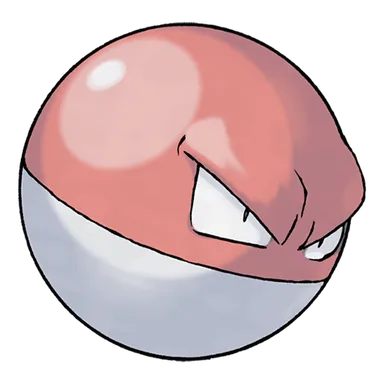
Voltorb evolves into Electrode at level 30.
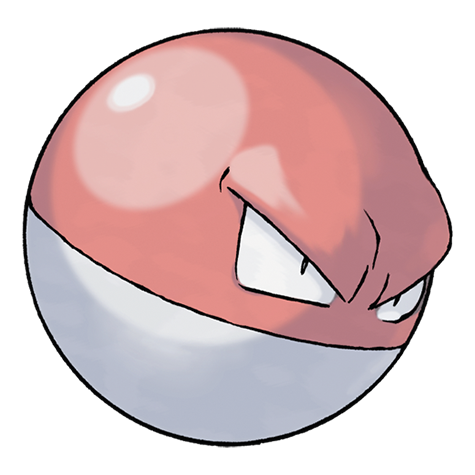 Voltorb
 Electrode
Forms
 Hisuian Electrode

Electrode Playthrough, Competitive, and Nuzlocke Usage
Using Electrode in a Playthrough
The Voltorb line is built around exceptional Speed and Electric utility rather than raw power or bulk. Standard Electrode can reliably move before most story opponents and use Electric STAB against Water- and Flying-types, while support options such as screens, paralysis, Volt Switch, or other utility vary by generation; its comparatively modest offensive stats can make neutral targets harder to remove quickly. Its access to Self-Destruct or Explosion can provide enormous emergency damage, but sacrificing a Pokemon is obviously undesirable in ordinary long-term play and especially in Nuzlockes. Hisuian Electrode adds Grass typing and Grass STAB, allowing it to pressure Ground- and Water-types that standard Electrode may struggle with, while retaining the line's defining extreme Speed.
Electrode in Competitive Pokémon
Standard Electrode has historically functioned primarily as a very fast support Pokemon or offensive pivot, using its Speed to establish screens, spread status, use Volt Switch, or perform other utility before the opponent moves. Its offensive stats are relatively modest, so speed control and team support have often been more important than direct wallbreaking. Hisuian Electrode has a clearer offensive niche because Electric/Grass STAB lets it threaten both Water-types and many Ground-types, while Smogon describes it as an effective fast pivot capable of outspeeding entire unboosted lower-tier metagames. Its low bulk and limited raw power still require frequent use of pivoting rather than prolonged direct exchanges.
Electrode in Nuzlockes
Electrode's major Nuzlocke advantage is offensive safety through Speed: it can usually attack, paralyze, or establish support before taking a hit. In FireRed and LeafGreen, however, community analysis considers it one of the weaker Kanto Electric-types because its damage output and coverage are limited despite its exceptional Speed; it still provides useful Electric STAB against important Water and Flying opponents. Self-Destruct and Explosion are generally poor routine options under permadeath rules, removing one of the line's more distinctive offensive tools. Hisuian Electrode benefits from Grass STAB and broader type coverage, though its additional weaknesses and recoil-heavy Chloroblast mean its expanded offense does not automatically make every matchup safer.
Learnsets
53 moves · Scarlet Violet
Level Up






Machine



Pokédex Entries
14 entries
It stores electric energy under very high pressure. It often explodes with little or no provocation.
Stores electrical energy inside its body. Even the slightest shock could trigger a huge explosion.
It is dangerous. If it has too much electricity and has nothing to do, it amuses itself by exploding.
It stores an overflowing amount of electric energy inside its body. Even a small shock makes it explode.
The more energy it charges up, the faster it gets. But this also makes it more likely to explode.
ELECTRODE eats electricity in the atmosphere. On days when lightning strikes, you can see this POKéMON exploding all over the place from eating too much electricity.
One of ELECTRODE’s characteristics is its attraction to electricity. It is a problematical POKéMON that congregates mostly at electrical power plants to feed on electricity that has just been generated.
They appear in great numbers at electric power plants. Because they feed on electricity, they cause massive and chaotic blackouts in nearby cities.
It explodes in response to even minor stimuli. It is feared, with the nickname of “The Bomb Ball.”
It is known to drift on winds if it is bloated to bursting with stored electricity.
It stores an overflowing amount of electric energy inside its body. Even a small shock makes it explode.
Electrode eats electricity in the atmosphere. On days when lightning strikes, you can see this Pokémon exploding all over the place from eating too much electricity.
One of Electrode’s characteristics is its attraction to electricity. It is a problematical Pokémon that congregates mostly at electrical power plants to feed on electricity that has just been generated.
The tissue on the surface of its body is curiously similar in composition to an Apricorn. When irritated, this Pokémon lets loose an electric current equal to 20 lightning bolts.
Where To Find Electrode
10 locations
Team Rocket's Castle · AlolaOne-time · version details vary
Team Rockets Castle Area
New Mauville · HoennOne-time, Walking · version details vary
New Mauville
Team Aqua Hideout · HoennOne-time · version details vary
Team Aqua Hideout Area
Team Magma Hideout · HoennOne-time · version details vary
Team Magma Hideout Area
Team Rocket HQ · JohtoOne-time · version details vary
Team Rocket HQ
Friend Safari · KalosWalking · version details vary
Friend Safari (Electric)
Lost Hotel · KalosWalking · version details vary
Lost Hotel
Cerulean Cave · KantoWalking · version details vary
Cerulean Cave (1F)
Cerulean Cave (2F)
Cerulean Cave (B1F)
Cinnabar Island · KantoNpc Trade · version details vary
Cinnabar Lab (Cinnabar Island)
Kanto Power Plant · KantoOne-time, Overworld · version details vary
Power Plant
Additional Images
PokeAPI sprites
Open this section to load extra PokeAPI sprite images.
Electrode Biology and Behavior
Electrode consumes freshly generated electricity around power plants and can draw enough power to cause blackouts. Increasing stored electrical energy makes it move faster, and when exceptionally full it can become light enough to drift with the wind. Unlike Voltorb, Electrode can intentionally control when it explodes and may detonate in response to stimulation, excess stored energy, or simply for its own amusement. Anime depictions show that defensive explosions consume large amounts of its energy and leave it exhausted afterward.
Electrode Biological Data
- National Pokédex
- #101
- Species
- Ball Pokémon
- Height
- 3' 11" (1.2 m)
- Weight
- 146.8 lbs (66.6 kg)
- Habitat
- Urban
- Color
- Red
- Body Style
- Ball
- Gender
- Genderless
Misc
Catch Rate: 60
Base Experience: 172 Exp
Hatch Counter: 20
Electrode Size Comparison: BETA
Electrode is listed at 3' 11" (1.2 m) and shown in an in-chart visual comparison.


How is visual size determined?
Pokédex height is treated as the official listed measurement, but the chart uses pose-aware visual scaling so each sprite looks reasonable in a direct comparison.
For long or coiled Pokémon, the listed height may represent total body length rather than upright height. For Pokémon with floppy ears, leaves, feathers, antennae, wings, or other flexible features, the chart usually measures to the top of the solid, substantial part of the head or body instead of the tallest decorative feature.
The goal is not to replace the official height, but to make the artwork compare naturally at the size it appears to occupy.