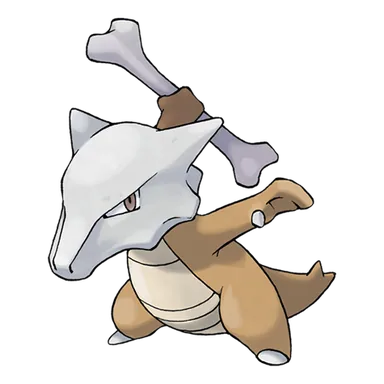
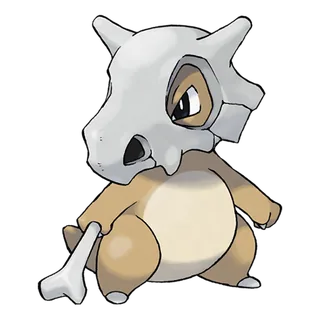
Cubone is a Ground-type Pokémon introduced in Generation I and the first stage of its evolution line, with a base stat total of 320.
Cubone

Abilities
Prevents recoil damage.
Draws electrical moves.
Blocks critical hits.
Hidden AbilityBase Stats
Cubone's Weaknesses and Resistances






Evolution Chain
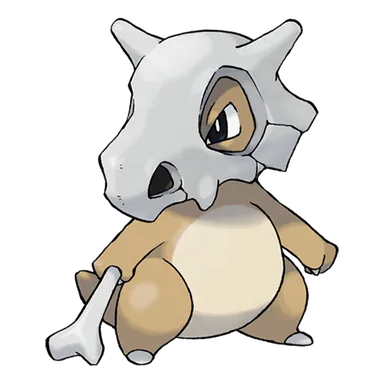
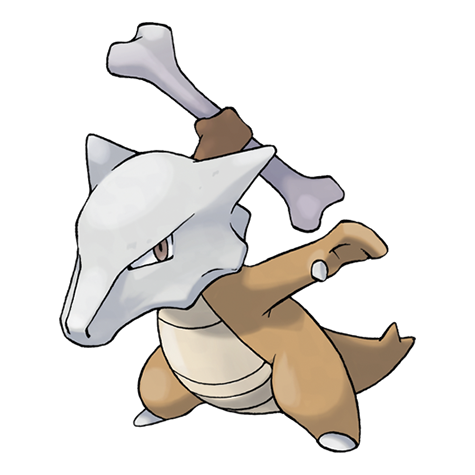
Cubone evolves into Marowak at level 28.
 Cubone
 Marowak
Cubone Playthrough, Competitive, and Nuzlocke Usage
Using Cubone in a Playthrough
The Cubone line develops into a slow, physically sturdy Ground-type whose offensive value changes dramatically if a Thick Club is available. Standard Marowak has good physical Defense and reliable Ground STAB but low Speed, so without item support it often competes poorly with faster or more naturally powerful Ground-types; Thick Club doubles the Attack of Cubone and Marowak and can turn the line into an extremely powerful physical attacker. Alolan Marowak becomes Fire/Ghost rather than Ground, gaining useful immunities and strong dual STAB while retaining access to Thick Club, and abilities such as Rock Head can support powerful recoil-free Fire attacks in applicable generations. Both Marowak forms are slow enough that careful switching and matchup selection matter more than simply overpowering every opponent.
Cubone in Competitive Pokémon
Standard Marowak's competitive identity is inseparable from Thick Club, which doubles its Attack and gives an otherwise modestly statted Pokemon genuine wallbreaking power. Its low Speed makes Trick Room or careful prediction valuable, while Ground STAB and physical coverage allow it to punish slower teams once safely positioned. Alolan Marowak developed a substantially stronger competitive niche through the combination of Thick Club, Fire/Ghost STAB, defensive immunities, and abilities such as Rock Head, with Smogon describing it as a powerful wallbreaker capable of forcing out bulky opponents. The shared weakness of both forms is very low Speed, making them vulnerable to faster offensive pressure despite their enormous item-boosted damage.
Cubone in Nuzlockes
Standard Marowak is highly variable in Nuzlockes because Thick Club changes its performance dramatically. FireRed and LeafGreen community discussion generally places ordinary Marowak in the middle or lower-middle range because it is slow, competes with several other Ground-types, and is encountered in an area where obtaining Cubone can mean missing the Gastly line under standard one-encounter rules; the same discussions note that a Thick Club Marowak becomes dramatically stronger. Its physical Defense is useful, but low Speed and weaker special durability make Water-, Grass-, and Ice-type attacks particularly dangerous. Alolan Marowak gains valuable Normal and Fighting immunities and strong Fire/Ghost offense, but its several common weaknesses still reward deliberate switching rather than blind use.
Learnsets
14 moves · Brilliant Diamond Shining Pearl
Level Up — Brilliant Diamond Shining Pearl





Pokédex Entries
18 entries
Because it never removes its skull helmet, no one has ever seen this POKéMON's real face.
Wears the skull of its deceased mother. Its cries echo inside the skull and come out as a sad melody.
If it is sad or lonely, the skull it wears shakes, and emits a plaintive and mournful sound.
It always wears the skull of its dead mother, so no one has any idea what its hidden face looks like.
It lost its mother after its birth. It wears its mother's skull, never revealing its true face.
CUBONE pines for the mother it will never see again. Seeing a likeness of its mother in the full moon, it cries. The stains on the skull the POKéMON wears are made by the tears it sheds.
It pines for the mother it will never see again. Seeing a likeness of its mother in the full moon, it cries. The stains on the skull it wears are from its tears.
It wears the skull of its dead mother on its head. When it becomes lonesome, it is said to cry loudly.
Because it never removes its skull helmet, no one has ever seen this POKéMON’s real face.
When it thinks of its dead mother, it cries. Its crying makes the skull it wears rattle hollowly.
If it is sad or lonely, the skull it wears shakes and emits a plaintive and mournful sound.
Cubone pines for the mother it will never see again. Seeing a likeness of its mother in the full moon, it cries. The stains on the skull the Pokémon wears are made by the tears it sheds.
When it thinks of its deceased mother, it weeps loudly. Mandibuzz that hear its cries will attack it from the air.
The skull it wears on its head is that of its dead mother. According to some, it will evolve when it comes to terms with the pain of her death.
At night, it weeps loudly for its dead mother, but those cries only attract its natural enemy—Mandibuzz.
It wears its mother’s skull on its head, so no one knows what its bare face looks like. However, it’s clear that it’s always crying.
When the memory of its departed mother brings it to tears, its cries echo mournfully within the skull it wears on its head.
This Pokémon wears the skull of its deceased mother. Sometimes Cubone’s dreams make it cry, but each tear Cubone sheds makes it stronger.
Where To Find Cubone
9 locations
Wela Volcano Park · AlolaWalking · version details vary
Wela Volcano Park Area
Goldenrod City · JohtoGift · version details vary
Goldenrod City Game Corner
Johto Safari Zone · JohtoWalking · version details vary
Safari Zone Desert
Glittering Cave · KalosWalking · version details vary
Glittering Cave (unknown area 303)
Pokémon Tower · KantoWalking, Overworld · version details vary
Pokemon Tower (3F)
Pokemon Tower (4F)
Pokemon Tower (5F)
Pokemon Tower (6F)
Pokemon Tower (7F)
Rock Tunnel · KantoWalking, Overworld · version details vary
Rock Tunnel (1F)
Rock Tunnel (B1F)
Safari Zone · KantoWalking · version details vary
Safari Zone (Area 1, east)
Safari Zone (Area 2, north)
Safari Zone (Area 3, west)
Sevault Canyon · KantoWalking · version details vary
Sevault Canyon
Route 203 · SinnohWalking · version details vary
Road 203
Held Items
1 items
- Ruby: 5% chance
- Sapphire: 5% chance
- Emerald: 5% chance
- Firered: 5% chance
- Leafgreen: 5% chance
- Diamond: 5% chance
- Pearl: 5% chance
- Platinum: 5% chance
- Heartgold: 5% chance
- Soulsilver: 5% chance
- Black: 5% chance
- White: 5% chance
- Black 2: 5% chance
- White 2: 5% chance
- X: 5% chance
- Y: 5% chance
- Omega Ruby: 5% chance
- Alpha Sapphire: 5% chance
- Sun: 5% chance
- Moon: 5% chance
- Ultra Sun: 5% chance
- Ultra Moon: 5% chance
Additional Images
PokeAPI sprites
Open this section to load extra PokeAPI sprite images.
Cubone Biology and Behavior
Cubone wears the skull of its deceased mother and is strongly associated with solitary behavior and grief following her death. It frequently cries at night, particularly during a full moon, and its tears leave marks on the skull; the skull itself vibrates while Cubone cries and produces a mournful sound. Despite its small and timid body, Cubone survives through exceptional skill with the bone it carries as a weapon. It tends to avoid social situations while young because of the trauma associated with losing its mother.
Cubone Biological Data
- National Pokédex
- #104
- Species
- Lonely Pokémon
- Height
- 1' 4" (0.4 m)
- Weight
- 14.3 lbs (6.5 kg)
- Habitat
- Mountain
- Color
- Brown
- Body Style
- Upright
- Gender
- 50% female / 50% male
Misc
Catch Rate: 190
Base Experience: 64 Exp
Hatch Counter: 20
Cubone Size Comparison: BETA
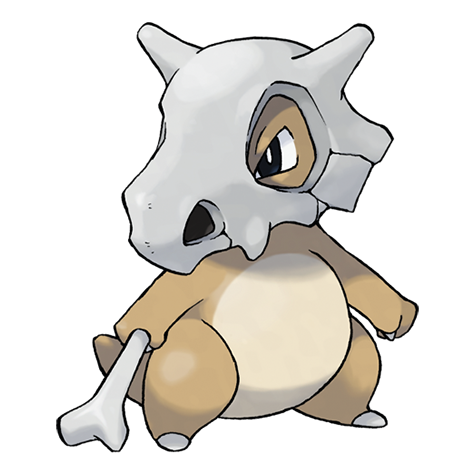
Cubone is listed at 1' 4" (0.4 m); this chart uses a pose-adjusted visual scale.

How is visual size determined?
Pokédex height is treated as the official listed measurement, but the chart uses pose-aware visual scaling so each sprite looks reasonable in a direct comparison.
For long or coiled Pokémon, the listed height may represent total body length rather than upright height. For Pokémon with floppy ears, leaves, feathers, antennae, wings, or other flexible features, the chart usually measures to the top of the solid, substantial part of the head or body instead of the tallest decorative feature.
The goal is not to replace the official height, but to make the artwork compare naturally at the size it appears to occupy.
Cubone currently uses a pose-adjusted visual scale.