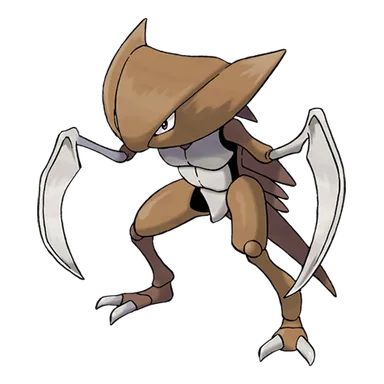
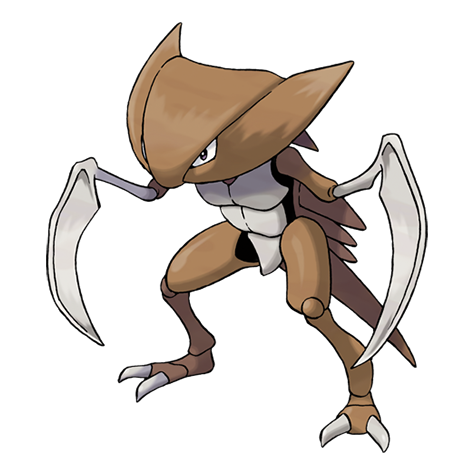
Kabuto is a Rock/Water-type Pokémon introduced in Generation I and the first stage of its evolution line, with a base stat total of 355.

Kabuto


Abilities
Raises SPEED in rain.
Blocks critical hits.
Physical attacks lower Defense and raise Speed.
Hidden AbilityBase Stats
Kabuto's Weaknesses and Resistances






Evolution Chain
Kabuto evolves into Kabutops at level 40.
 Kabuto
 Kabutops
Kabuto Playthrough, Competitive, and Nuzlocke Usage
Using Kabuto in a Playthrough
The Kabuto line develops into Kabutops, a fast physical Water/Rock attacker whose effectiveness improved substantially after the physical/special split allowed physical Water moves to use its high Attack. In older games, Water STAB relied on Kabutops's much weaker Special Attack, leaving Rock and Normal coverage to do much of the physical work. Later movepools add options such as Waterfall, Aqua Jet, Stone Edge, Swords Dance, and Swift Swim-based rain offense. Like Omastar, it arrives late as a fossil in Kanto and carries a dangerous quadruple Grass weakness.
Kabuto in Competitive Pokémon
Kabutops has historically functioned as a rain sweeper and, in several generations, an offensive Rapid Spin user. Swift Swim patches its Speed in rain while simultaneously strengthening Water STAB, and Swords Dance or naturally high Attack can make it difficult to wall. Rock STAB provides complementary coverage, while Aqua Jet offers priority in relevant generations. Its defensive typing and dependence on rain or setup generally keep it from being as reliable outside specialized teams.
Kabuto in Nuzlockes
Kabutops is a more natural Nuzlocke attacker after Generation IV than before it because physical Water STAB finally aligns with its high Attack. In Kanto, late fossil revival, the need to grind Kabuto to level 40, and pre-split Water mechanics limit the payoff despite strong physical stats. It can still handle selected Fire-, Flying-, and physical opponents effectively, but Grass attacks are exceptionally dangerous and Electric, Fighting, and Ground coverage also require caution. Later games make it much more coherent offensively without solving those defensive risks.
Learnsets
14 moves · Brilliant Diamond Shining Pearl
Level Up — Brilliant Diamond Shining Pearl





Pokédex Entries
18 entries
A POKéMON that was resurrected from a fossil found in what was once the ocean floor eons ago.
A POKéMON that was recovered from a fossil. It uses the eyes on its back while hiding on the sea floor.
On rare occasions, some have been found as fossils which they became while hiding on the ocean floor.
This POKéMON lived in ancient times. On rare occasions, it has been discovered as a living fossil.
Three hundred million years ago, it hid on the sea floor. It also has eyes on its back that glow.
KABUTO is a POKéMON that has been regenerated from a fossil. However, in extremely rare cases, living examples have been discovered. The POKéMON has not changed at all for 300 million years.
It is a POKéMON that has been regenerated from a fossil. However, in rare cases, living examples have been discovered. KABUTO have not changed for 300 million years.
This POKéMON was regenerated from the fossil of an ancient creature. It protects itself with a hard shell.
A POKéMON that was regenerated from a fossil found in what was once the ocean floor long ago.
It is thought to have inhabited beaches 300 million years ago. It is protected by a stiff shell.
This Pokémon lived in ancient times. On rare occasions, it has been discovered as a living fossil.
This Pokémon was regenerated from the fossil of an ancient creature. It protects itself with a hard shell.
Kabuto is a Pokémon that has been regenerated from a fossil. However, in extremely rare cases, living examples have been discovered. The Pokémon has not changed at all for 300 million years.
This Pokémon thrived 300 million years ago. It’s said that living specimens can still be seen in a certain region—a rare sight.
This Pokémon became extinct everywhere, except in a few areas. It protects itself with its hard shell.
A Pokémon that was recovered from a fossil. It used the eyes on its back while hiding on the seafloor.
This species is almost entirely extinct. Kabuto molt every three days, making their shells harder and harder.
While some say this species has gone extinct, Kabuto sightings are apparently fairly common in some places.
Where To Find Kabuto
4 locations
Route 8 · AlolaGift · version details vary
Alola Route 8 Fossil Restoration Center
Cinnabar Island · KantoGift · version details vary
Cinnabar Lab (Cinnabar Island)
Pewter City · KantoGift · version details vary
Pewter Museum of Science
Oreburgh City · SinnohGift · version details vary
Oreburgh Mining Museum
Additional Images
PokeAPI sprites
Open this section to load extra PokeAPI sprite images.
Kabuto Biology and Behavior
Kabuto is an ancient marine Pokemon that has survived almost unchanged for hundreds of millions of years, with rare living populations documented despite its status as a fossil species. It has eyes on both the upper and lower surfaces of its body and is a fast, powerful swimmer. Its habitat is associated with ancient and modern coastal waters.
Kabuto Biological Data
- National Pokédex
- #140
- Species
- Shellfish Pokémon
- Height
- 1' 8" (0.5 m)
- Weight
- 25.4 lbs (11.5 kg)
- Habitat
- Sea
- Color
- Brown
- Body Style
- Armor
- Gender
- 12.5% female / 87.5% male
Misc
Catch Rate: 45
Base Experience: 71 Exp
Hatch Counter: 30
Kabuto Size Comparison: BETA
Kabuto is listed at 1' 8" (0.5 m) and shown in an in-chart visual comparison.


How is visual size determined?
Pokédex height is treated as the official listed measurement, but the chart uses pose-aware visual scaling so each sprite looks reasonable in a direct comparison.
For long or coiled Pokémon, the listed height may represent total body length rather than upright height. For Pokémon with floppy ears, leaves, feathers, antennae, wings, or other flexible features, the chart usually measures to the top of the solid, substantial part of the head or body instead of the tallest decorative feature.
The goal is not to replace the official height, but to make the artwork compare naturally at the size it appears to occupy.