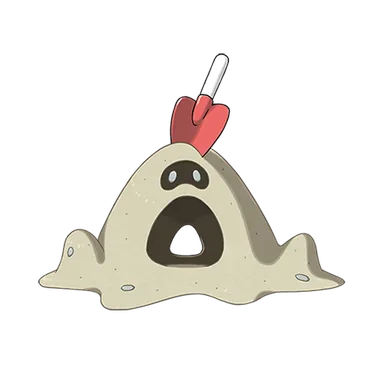
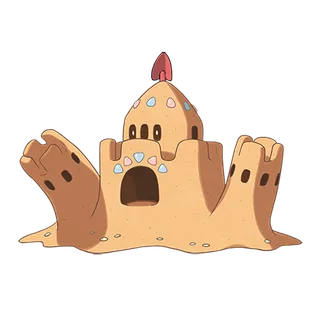
Palossand is a Ghost/Ground-type Pokémon introduced in Generation VII and a final stage of its evolution line, with a base stat total of 480.
Palossand


Abilities
Boosts the Pokémon’s Defense stat sharply when hit by a Water-type move.
Ups evasion in a sandstorm.
Hidden AbilityBase Stats
Palossand's Weaknesses and Resistances








Evolution Chain
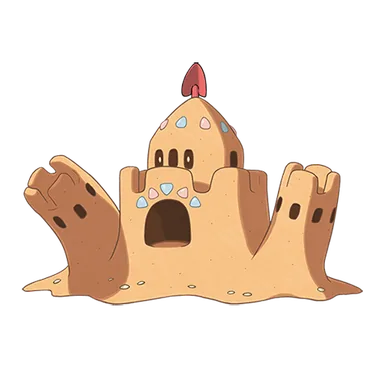
Sandygast evolves into Palossand at level 42.
 Sandygast
 Palossand
 Playthrough, Competitive, and Nuzlocke Usage
Using Palossand in a Playthrough
Sandygast evolves into Palossand at level 42, which is relatively late for a two-stage line and leaves the player using the weaker first stage for a substantial part of the game if it is caught early. Palossand becomes a slow but sturdy Ghost/Ground special attacker and wall with base 85 HP, 110 Defense, 100 Special Attack, and only 35 Speed, while its typing grants complete immunities to Normal, Fighting, and Electric attacks. Shore Up provides reliable recovery and becomes even stronger during sandstorm, while Earth Power and Shadow Ball offer accurate dual STAB and Stealth Rock can add long-term team support where available. Water Compaction sharply raises Defense when Palossand is hit by a Water-type move, but it does not reduce or negate the Water damage itself; because Water is super effective and many Water attacks are special, intentionally absorbing a strong Water move can still be extremely dangerous. Its other weaknesses to Grass, Ice, Ghost, and Dark and mediocre base 75 Special Defense mean its physical bulk is much more reliable than its special durability. Bold is a natural Nature for maximizing the physical-wall role, while Modest can be useful in a conventional playthrough when stronger Earth Power and Shadow Ball damage is preferable to still more Defense.
Palossand in Competitive Pokémon
Palossand has consistently occupied a lower-tier defensive niche built around the rare combination of Ghost/Ground typing, Stealth Rock, reliable recovery, and meaningful Special Attack. In Generation VII it was an NU Pokémon that checked several physical Fighting-types, blocked Rapid Spin through its Ghost typing, and used Shore Up to remain healthy while setting Stealth Rock. Unlike many passive hazard setters, base 100 Special Attack and STAB Earth Power and Shadow Ball allowed Palossand to threaten certain opposing setters and Magic Bounce users rather than conceding momentum automatically. Water Compaction could make already strong physical bulk even more extreme after weak Water attacks such as priority Aqua Jet, but the Ability never removed Palossand's underlying Water weakness and was therefore not a universal defensive solution. Scarlet/Violet currently places Palossand in PU, where it still functions as a physically defensive Stealth Rock setter and spinblocker with Shore Up, showing remarkable continuity in its basic role despite generational power creep. Its ceiling has always been limited by very low Speed, only moderate special bulk, common Dark/Ghost/Grass/Ice/Water weaknesses, and the fact that stronger special attackers can bypass the Defense advantages that define its niche.
Palossand in Nuzlockes
Palossand can be an excellent Nuzlocke defensive specialist because three immunities—Normal, Fighting, and Electric—create completely safe switch opportunities when enemy movesets are known. Its high physical Defense, Shore Up, and resistance to Bug and Rock also make it reliable against many physical opponents, while accurate Earth Power and Shadow Ball allow it to contribute without depending entirely on status or stall. The late level-42 evolution is the main developmental drawback, since Sandygast is much less durable and base 15 Speed leaves it exposed while the player waits for the final stage. Water Compaction should never be mistaken for a Water immunity: the Defense boost occurs after Palossand is damaged, and a strong special Water move may simply knock it out before that physical Defense increase becomes useful. Dark, Ghost, Grass, Ice, and Water coverage therefore need to be checked carefully, and its low Speed means an unexpected super-effective attack often lands before Palossand can heal or retaliate. Shore Up significantly improves long-term survival, but conserving its PP is important in extended routes or challenge rulesets because Palossand often wins through repeated defensive exchanges rather than quick sweeps.
Learnsets
60 moves · Scarlet Violet
Level Up





Machine

Pokédex Entries
6 entries
Possessed people controlled by this Pokémon transformed its sand mound into a castle. As it evolved, its power to curse grew ever stronger.
Buried beneath the castle are masses of dried-up bones from those whose vitality it has drained.
Each of its grains of sand has its own will. Palossand eats small Pokémon and siphons away their vital essence while they’re still alive.
Once it has whipped up a sandstorm to halt its opponents in their tracks, this terrifying Pokémon snatches away their vitality.
Palossand is known as the Beach Nightmare. It pulls its prey down into the sand by controlling the sand itself, and then it sucks out their souls.
This Pokémon lives on beaches, but it hates water. Palossand can’t maintain its castle-like shape if it gets drenched by a heavy rain.
Held Items
1 items
- Sun: 5% chance
- Moon: 5% chance
- Ultra Sun: 5% chance
- Ultra Moon: 5% chance
Additional Images
PokeAPI sprites
Open this section to load extra PokeAPI sprite images.
Palossand Biology and Behavior
Palossand can control the sand making up its body, with Pokédex material describing every grain as possessing a will of its own, and unlike Sandygast it can replenish lost sand without forcing others to rebuild it. It nevertheless curses and controls humans and Pokémon to gather additional sand, while the shovel on its tower rotates when searching for prey and is believed to function like a radar. Smaller Pokémon can be dragged beneath its body and have their vitality drained until only dried bones remain; Palossand can then fire those bones from openings in its arms. The lingering ill will of its victims is said to seep into surrounding sand and become the origin of new Sandygast, creating a direct supernatural life-cycle connection between predation by Palossand and the appearance of its pre-evolution. Although it inhabits beaches, Palossand hates water and loses the ability to maintain its castle structure under heavy rain. Animated material shows that it can greatly increase its apparent size and generate sandstorms, reinforcing the degree of control it exercises over the material surrounding its body.
Palossand Biological Data
- National Pokédex
- #770
- Species
- Sand Castle Pokémon
- Height
- 4' 3" (1.3 m)
- Weight
- 551.2 lbs (250.0 kg)
- Habitat
- Currently Unknown
- Color
- Brown
- Body Style
- Squiggle
- Gender
- 50% female / 50% male
Misc
Catch Rate: 60
Base Experience: 168 Exp
Hatch Counter: 15
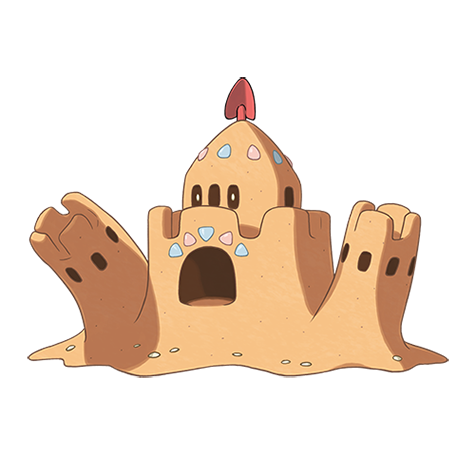
Palossand Size Comparison: BETA
Palossand is listed at 4' 3" (1.3 m); this chart uses a pose-adjusted visual scale.

How is visual size determined?
Pokédex height is treated as the official listed measurement, but the chart uses pose-aware visual scaling so each sprite looks reasonable in a direct comparison.
For long or coiled Pokémon, the listed height may represent total body length rather than upright height. For Pokémon with floppy ears, leaves, feathers, antennae, wings, or other flexible features, the chart usually measures to the top of the solid, substantial part of the head or body instead of the tallest decorative feature.
The goal is not to replace the official height, but to make the artwork compare naturally at the size it appears to occupy.
Palossand currently uses a pose-adjusted visual scale.