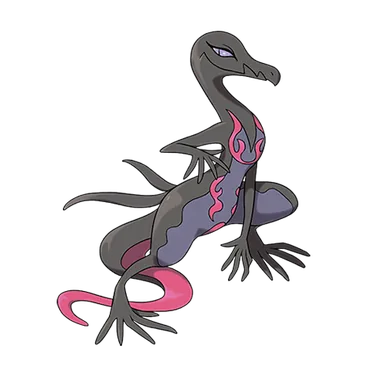
Salandit is a Poison/Fire-type Pokémon introduced in Generation VII and the first stage of its evolution line, with a base stat total of 320.
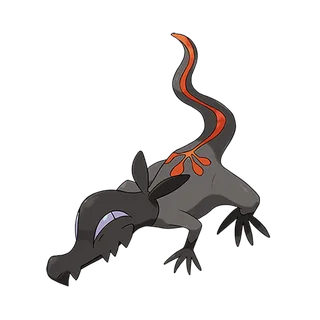
Salandit


Abilities
Base Stats
Salandit's Weaknesses and Resistances









Evolution Chain
Salandit evolves into Salazzle by leveling up at level 33female only.
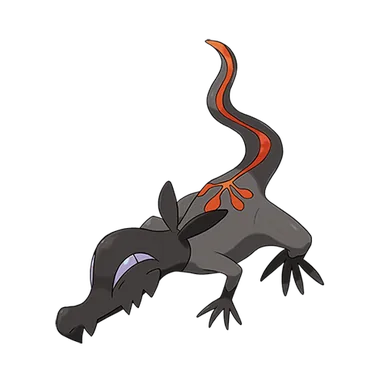 Salandit
 Salazzle
Salandit Playthrough, Competitive, and Nuzlocke Usage
Using Salandit in a Playthrough
Salandit is available early enough in Alola to become a useful Fire/Poison attacker, but only female Salandit can evolve into Salazzle at level 33, and females make up only one eighth of ordinary Salandit encounters. That gender restriction is the line's largest practical drawback during a normal playthrough: a male Salandit permanently remains the much weaker first stage unless the player replaces it. Salazzle rewards the effort with base 117 Speed and 111 Special Attack, excellent special STAB from moves such as Flamethrower and Sludge Bomb, and a typing that strongly resists Bug, Fairy, and Grass while also resisting Fighting, Fire, Ice, Poison, and Steel. Its Corrosion Ability is unique strategically because it allows Salazzle to poison even Poison- and Steel-type targets, while Nasty Plot can turn its already strong Special Attack into genuine sweeping power; from Generation VIII onward, Oblivious also blocks Intimidate in addition to preventing infatuation and Taunt. The line is extremely frail, however, and Salazzle has a crippling 4× Ground weakness along with weaknesses to Water, Rock, and Psychic, so it performs far better when attacking first than when asked to switch into neutral damage. Timid is usually the safest beneficial Nature because preserving Salazzle's exceptional Speed is central to its role, while Modest can be justified in ordinary play when the additional damage matters more than the narrowest Speed benchmarks.
Salandit in Competitive Pokémon
Salazzle has maintained a respectable lower-tier competitive career because very high Speed, strong Fire/Poison STAB, Nasty Plot, and Corrosion give it tools that most other frail Fire-types lack. In Generation VII it was an important RU threat, where base 117 Speed let it outrun much of the unboosted metagame and Z-Moves could help Nasty Plot sets break specially bulky answers that would otherwise survive its attacks. Corrosion also supported specialized Toxic sets by allowing Salazzle to badly poison Steel- and Poison-types that normally ignore Toxic, creating a stallbreaking niche distinct from its direct offensive sets. In Sword and Shield it fell to NU but remained dangerous as a fast Nasty Plot sweeper and utility attacker; Heavy-Duty Boots also reduced the cost of repeatedly switching a Fire-type through Stealth Rock. Scarlet and Violet currently place Salazzle in PU, where the same combination of Speed, Nasty Plot, Fire/Poison coverage, and disruptive status remains effective but its terrible physical bulk, 4× Ground weakness, and difficulty breaking some specially bulky opponents keep it from sustaining higher usage. Salazzle therefore has real competitive history across several generations, but its career is that of a dangerous specialized lower-tier attacker rather than a stable OU presence.
Salandit in Nuzlockes
The first Nuzlocke challenge with this family is obtaining the correct individual: because only female Salandit evolve and females are uncommon, a ruleset that permits only the first encounter in an area may leave the player with a permanently unevolved male. A female that reaches level 33 becomes much more useful, as Salazzle's base 117 Speed lets it avoid many hits entirely by securing the knockout first. Its numerous resistances and Poison immunity create safe entries against known Bug-, Fairy-, Grass-, Fighting-, Fire-, Ice-, Poison-, or Steel-type moves, but its low defensive stats mean even resisted damage should not be treated casually over a long battle. The 4× Ground weakness is the critical danger: an unexpected Earthquake, High Horsepower, or similar coverage move can erase Salazzle before its Speed matters. Flamethrower and Sludge Bomb provide reliable, accurate STAB, while Corrosion-backed Toxic can safely wear down certain defensive enemies that Salazzle cannot overpower directly. Nasty Plot is best used only when the opposing Pokémon is genuinely unable to threaten Salazzle, because spending a turn setting up with such frail defenses creates much less margin for an incorrect damage estimate than simply attacking.
Learnsets
64 moves · Scarlet Violet
Level Up






Machine


Egg
Pokédex Entries
6 entries
It burns its bodily fluids to create a poisonous gas. When its enemies become disoriented from inhaling the gas, it attacks them.
Volcanoes or dry, craggy places are its home. It emanates a sweet-smelling poisonous gas that attracts bug Pokémon, then attacks them.
The males will do whatever the females tell them. They give the females most of their food. Due to malnutrition, the males can’t evolve.
It weakens opponents and sends them reeling with its poisonous gas. Salandit doesn’t deal well with Spinda, since it’s always reeling.
Its venom sacs produce a fluid that this Pokémon then heats up with the flame in its tail. This process creates Salandit’s poisonous gas.
This sneaky Pokémon will slink behind its prey and immobilize it with poisonous gas before the prey even realizes Salandit is there.
Where To Find Salandit
4 locations
Lush Jungle · AlolaWalking · version details vary
Lush Jungle East Cave
Route 8 · AlolaWalking · version details vary
Alola Route 8 Main
Wela Volcano Park · AlolaWalking · version details vary
Wela Volcano Park Area
Motostoke Outskirts · GalarOverworld · version details vary
Motostoke Outskirts
Held Items
1 items
- Sun: 5% chance
- Moon: 5% chance
- Ultra Sun: 5% chance
- Ultra Moon: 5% chance
Additional Images
PokeAPI sprites
Open this section to load extra PokeAPI sprite images.
Salandit Biology and Behavior
Salandit inhabits volcanic and dry rocky environments and can produce both flames and poisonous gas from markings near the base of its tail. The gas is created by burning bodily fluids and has a sweet odor that causes dizziness; Bug Pokémon are attracted to the smell and become common prey. Female Salandit additionally release powerful pheromones capable of attracting males of their own species and even affecting other species, including humans. Male Salandit surrender much of their food to females under this influence, leaving them malnourished enough that they do not develop into Salazzle. Although physically unimpressive compared with its evolution, Salandit compensates with deceptive movement, poison, and other tactics intended to unbalance opponents before attacking.
Salandit Biological Data
- National Pokédex
- #757
- Species
- Toxic Lizard Pokémon
- Height
- 2' 0" (0.6 m)
- Weight
- 10.6 lbs (4.8 kg)
- Habitat
- Currently Unknown
- Color
- Black
- Body Style
- Quadruped
- Gender
- 12.5% female / 87.5% male
Misc
Catch Rate: 120
Base Experience: 64 Exp
Hatch Counter: 20
Salandit Size Comparison: BETA
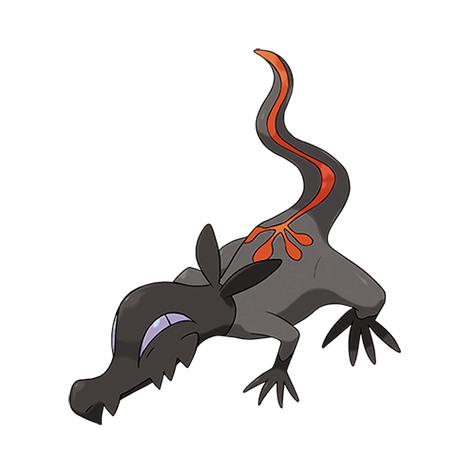
Salandit is listed at 2' 0" (0.6 m); this chart uses a pose-adjusted visual scale.

How is visual size determined?
Pokédex height is treated as the official listed measurement, but the chart uses pose-aware visual scaling so each sprite looks reasonable in a direct comparison.
For long or coiled Pokémon, the listed height may represent total body length rather than upright height. For Pokémon with floppy ears, leaves, feathers, antennae, wings, or other flexible features, the chart usually measures to the top of the solid, substantial part of the head or body instead of the tallest decorative feature.
The goal is not to replace the official height, but to make the artwork compare naturally at the size it appears to occupy.
Salandit currently uses a pose-adjusted visual scale.