Ambipom is a Normal-type Pokémon introduced in Generation IV and a final stage of its evolution line, with a base stat total of 482.
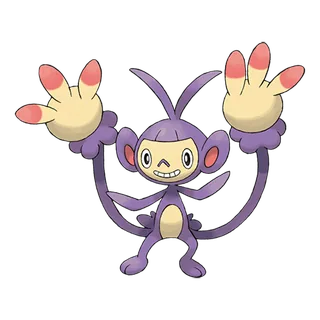
Ambipom

Abilities
Powers up the Pokémon’s weaker moves.
May pick up items.
Increases the frequency of multi-strike moves.
Hidden AbilityBase Stats
Ambipom's Weaknesses and Resistances


Evolution Chain
Aipom evolves into Ambipom by leveling up knowing Double Hit.
 Aipom
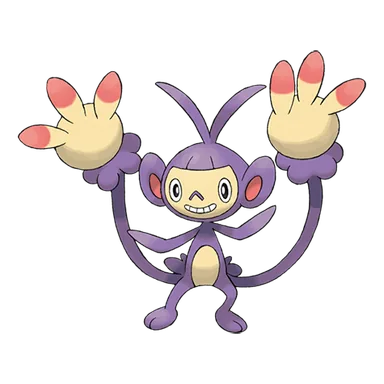 Ambipom
 Playthrough, Competitive, and Nuzlocke Usage
Using Ambipom in a Playthrough
Aipom begins as a fast but statistically modest Normal-type whose greatest strengths are Speed, broad move compatibility, and only a single conventional weakness to Fighting. In Generation II Aipom has no evolution and therefore struggles to keep pace with fully evolved Pokemon late in the story, but from Generation IV onward it can evolve into Ambipom by leveling up while knowing Double Hit. Ambipom is a major upgrade, reaching base 115 Speed and 100 Attack while gaining Technician as one of its standard abilities, which strengthens weaker attacks such as Fake Out and several coverage or utility moves. This makes Ambipom effective as a fast physical attacker and hit-and-run pivot, especially with Fake Out, Return or other Normal STAB where available, U-turn, Low Kick, elemental punches, Knock Off, and similar coverage depending on generation. Its main drawback is poor defensive staying power, so the line is at its best when it attacks first and switches out rather than trying to absorb repeated hits.
Ambipom in Competitive Pokémon
Ambipom's competitive identity has centered on extreme Speed, Technician, and one of the strongest Fake Outs available to an ordinary Normal-type. Technician boosts Fake Out and other low-base-power moves, while U-turn lets Ambipom exploit its base 115 Speed as an offensive pivot that chips an opponent and then brings in a better matchup. Life Orb, Silk Scarf, Knock Off, Low Kick, and coverage options have supported various offensive sets, while Skill Link has occasionally enabled multi-hit strategies in formats where its movepool allows them. Despite those tools, Ambipom has usually occupied lower tiers because base 100 Attack is only moderate by modern wallbreaking standards, Normal STAB provides little super-effective pressure, and its 75/66/66 bulk gives it few opportunities to take strong attacks. It is therefore a classic fast nuisance and momentum Pokemon rather than a durable sweeper, and competitive analyses frequently note that stronger pivots can perform similar roles with better typing or power.
Ambipom in Nuzlockes
Aipom can be a useful Nuzlocke encounter when obtained early because good Speed reduces the number of attacks it must take and pure Normal typing gives it a simple defensive profile with a Ghost immunity and only a Fighting weakness. The line becomes much more attractive from Generation IV onward, where Ambipom's base 115 Speed and Technician-boosted priority allow it to finish weakened opponents before they can retaliate. Its broad movepool can patch holes created by encounter luck, but mediocre defenses mean that failed damage calculations or unexpected Fighting coverage can be fatal. In Generation II, where Aipom cannot evolve, its usefulness declines significantly as stronger fully evolved Pokemon become available and it is better viewed as a temporary fast attacker or utility option. Ambipom is safest when used proactively—attacking first, exploiting Ghost immunity, or pivoting with U-turn—rather than as a general-purpose switch-in.
Learnsets
78 moves · Scarlet Violet
Level Up






Machine







Egg

Pokédex Entries
9 entries
To eat, it deftly shucks nuts with its two tails. It rarely uses its arms now.
They work in large colonies and make rings by linking their tails, apparently in friendship.
Split into two, the tails are so adept at handling and doing things, AMBIPOM rarely uses its hands.
They live on large trees. They are said to communicate by connecting their tails to those of others.
It is very difficult to dodge the consecutive strikes of its two tails.
Split into two, the tails are so adept at handling and doing things, Ambipom rarely uses its hands.
In their search for comfortable trees, they get into territorial disputes with groups of Passimian. They win about half the time.
It uses its tails for everything. If it wraps both of its tails around you and gives you a squeeze, that’s proof it really likes you.
To affirm their kinship, members of this species will form a ring by linking their newly doubled tails together. On rare occasions, humans have been accepted into such rings.
Where To Find Ambipom
2 locations
Poni Plains · AlolaSOS From Bubbling Spot · version details vary
Poni Plains West
Accumula Town · UnovaNpc Trade · version details vary
Accumula Town
Additional Images
PokeAPI sprites
Open this section to load extra PokeAPI sprite images.
Ambipom Biology and Behavior
Ambipom's single tail hand has divided into two highly dexterous tails, and the pair are so capable that the Pokemon rarely needs to use its ordinary arms at all. It can rapidly shell nuts with the two tail hands and move through forest canopies at high speed, using the tails for both balance and manipulation. Wild Ambipom live in large colonies and communicate by linking or touching their tails; forming a ring with another individual's tails is treated as a sign of friendship, and Ambipom have occasionally offered the same gesture to humans. They also show affection by wrapping both tails around companions, live alongside their young Aipom, and in Alola engage in territorial competition with Passimian over desirable trees.
Ambipom Biological Data
- National Pokédex
- #424
- Species
- Long Tail Pokémon
- Height
- 3' 11" (1.2 m)
- Weight
- 44.8 lbs (20.3 kg)
- Habitat
- Currently Unknown
- Color
- Purple
- Body Style
- Upright
- Gender
- 50% female / 50% male
Misc
Catch Rate: 45
Base Experience: 169 Exp
Hatch Counter: 20
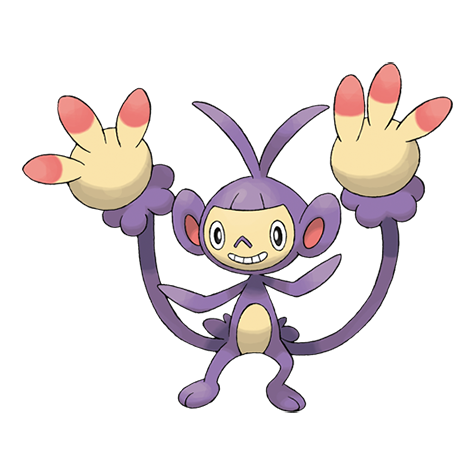
Ambipom Size Comparison: BETA
Ambipom is listed at 3' 11" (1.2 m); this chart uses a pose-adjusted visual scale.

How is visual size determined?
Pokédex height is treated as the official listed measurement, but the chart uses pose-aware visual scaling so each sprite looks reasonable in a direct comparison.
For long or coiled Pokémon, the listed height may represent total body length rather than upright height. For Pokémon with floppy ears, leaves, feathers, antennae, wings, or other flexible features, the chart usually measures to the top of the solid, substantial part of the head or body instead of the tallest decorative feature.
The goal is not to replace the official height, but to make the artwork compare naturally at the size it appears to occupy.
Ambipom currently uses a pose-adjusted visual scale.