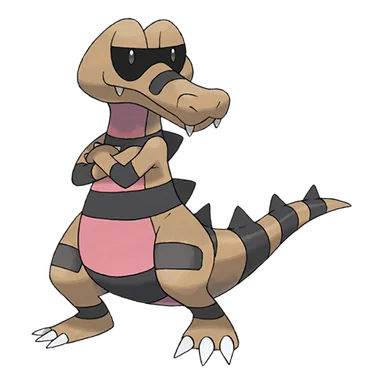
Krookodile is a Ground/Dark-type Pokémon introduced in Generation V and a final stage of its evolution line, with a base stat total of 519.
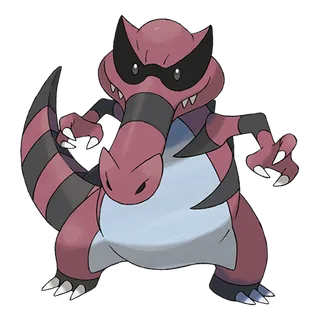
Krookodile


Abilities
Lowers the foe’s ATTACK.
Boosts Attack after knocking out any Pokémon.
Raises Attack upon taking a critical hit.
Hidden AbilityBase Stats
Krookodile's Weaknesses and Resistances










Evolution Chain
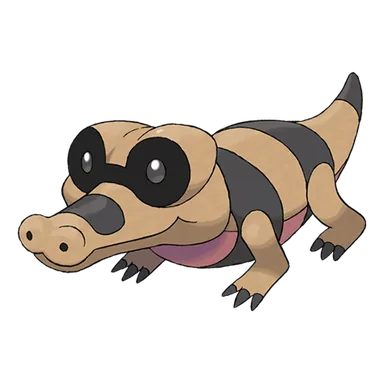
Sandile evolves into Krokorok at level 29, and Krokorok evolves into Krookodile at level 40.
 Sandile
 Krokorok
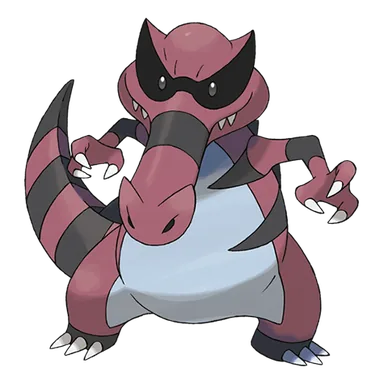 Krookodile
 Playthrough, Competitive, and Nuzlocke Usage
Using Krookodile in a Playthrough
Sandile evolves into Krokorok at level 29 and Krookodile at level 40, producing a Ground/Dark physical attacker with excellent offensive typing, base 117 Attack, and base 92 Speed. Krookodile's Defense was base 70 in Generation V and increased to 80 from Generation VI onward, slightly improving its ability to use Intimidate as a physical pivot. Earthquake and Crunch or later Knock Off form strong STAB, while Rock Slide or Stone Edge, Brick Break or Close Combat in later games, Gunk Shot, Stealth Rock, Taunt, and other coverage let it function as a breaker or utility attacker. Intimidate lowers opposing Attack on entry and is the safer all-purpose ability, while Moxie raises Krookodile's Attack after it scores a knockout and can quickly turn one KO into a sweep; Anger Point can maximize Attack after a critical hit but is much less predictable. Ground/Dark also gives complete Electric and Psychic immunities, although Water, Grass, Ice, Fighting, Bug, and later Fairy attacks are super effective. Jolly is usually ideal because base 92 Speed sits in a valuable but crowded range, while Adamant maximizes damage when the extra Speed is unnecessary.
Krookodile in Competitive Pokémon
Krookodile was a strong BW UU Pokemon and a common VGC 2011 choice because Intimidate, Moxie, Ground/Dark STAB, and base 92 Speed let it compress several roles into one slot. Choice Scarf sets were particularly effective: Earthquake and Crunch provided strong coverage, and Moxie could turn a revenge kill into a late-game sweep as Krookodile accumulated Attack boosts. Pursuit historically gave it an additional niche against Psychic- and Ghost-types, while later generations added stronger Knock Off, Stealth Rock, Taunt, and improved physical coverage. Its Defense increase from 70 to 80 after Generation V strengthened Intimidate utility sets, and modern SV Krookodile remains a strong RU progress-maker that can set hazards, remove items, and threaten sweeps with Choice items. Lack of reliable recovery and a large collection of common weaknesses keep it from functioning as a true wall, but few Ground-types have maintained such a consistent combination of offense, utility, and two premium immunities.
Krookodile in Nuzlockes
Krookodile is a very strong Nuzlocke Pokemon because both Intimidate and Moxie are useful without complicated setup. Intimidate immediately reduces physical damage when Krookodile enters and is generally the safest ability, while Moxie can let it snowball through teams once the first knockout is secured. Electric and Psychic immunities provide completely safe switches against known moves, but Water, Grass, Ice, Fighting, Bug, and later Fairy coverage can be dangerous and the line's special bulk is only average. Earthquake and Crunch are accurate, powerful attacks that do not cause recoil or stat drops, making them particularly friendly to permadeath play. Jolly Krookodile is often safer than Adamant when the extra Speed prevents a retaliation, and Anger Point should be regarded as an occasional bonus rather than a strategy worth deliberately triggering with a critical hit.
Learnsets
81 moves · Scarlet Violet
Level Up




Machine



Pokédex Entries
9 entries
They never allow prey to escape. Their jaws are so powerful, they can crush the body of an automobile.
It can expand the focus of its eyes, enabling it to see objects in the far distance as if it were using binoculars.
Very violent Pokémon, they try to clamp down on anything that moves in front of their eyes.
Its unique faculty of sight can detect small prey more than 30 miles away, even in the midst of a sandstorm.
After clamping down with its powerful jaws, it twists its body around to rip its prey in half.
When it spots prey, even at a distance of over 30 miles, it swims through the desert as if it were water, then jumps out and chomps them.
It conceals itself in sandstorms that Flygon whip up and waits patiently for prey to appear.
This Pokémon is known as the Bully of the Sands. Krookodile’s mighty jaws can bite through heavy plates of iron with almost no effort at all.
While terribly aggressive, Krookodile also has the patience to stay hidden under sand for days, lying in wait for prey.
Held Items
1 items
- Sun: 50% chance
- Moon: 50% chance
- Ultra Sun: 50% chance
- Ultra Moon: 50% chance
Additional Images
PokeAPI sprites
Open this section to load extra PokeAPI sprite images.
Krookodile Biology and Behavior
Krookodile is an exceptionally aggressive desert predator whose powerful jaws can crush automobiles and tear through thick iron plate. Its eyes can focus over very long distances, helping it spot prey across open desert, and it can move through loose sand almost as if swimming through water. Krookodile sometimes cooperates with Flygon, hiding inside Flygon's sandstorms while hunting and then sharing the captured prey. It has been nicknamed the 'Bully of the Sands' because of its violent hunting behavior.
Krookodile Biological Data
- National Pokédex
- #553
- Species
- Intimidation Pokémon
- Height
- 4' 11" (1.5 m)
- Weight
- 212.3 lbs (96.3 kg)
- Habitat
- Currently Unknown
- Color
- Red
- Body Style
- Upright
- Gender
- 50% female / 50% male
Misc
Catch Rate: 45
Base Experience: 234 Exp
Hatch Counter: 20
Krookodile Size Comparison: BETA
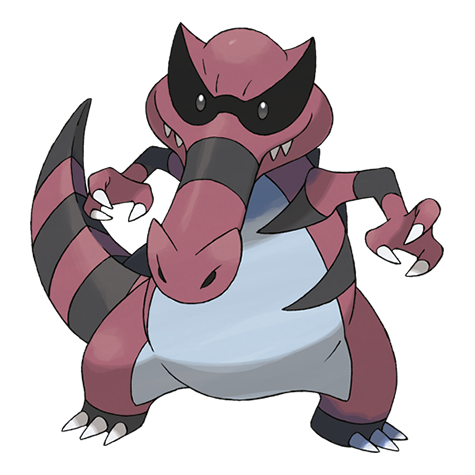
Krookodile is listed at 4' 11" (1.5 m) and shown in an in-chart visual comparison.

How is visual size determined?
Pokédex height is treated as the official listed measurement, but the chart uses pose-aware visual scaling so each sprite looks reasonable in a direct comparison.
For long or coiled Pokémon, the listed height may represent total body length rather than upright height. For Pokémon with floppy ears, leaves, feathers, antennae, wings, or other flexible features, the chart usually measures to the top of the solid, substantial part of the head or body instead of the tallest decorative feature.
The goal is not to replace the official height, but to make the artwork compare naturally at the size it appears to occupy.