Stakataka is a Rock/Steel-type Pokémon introduced in Generation VII, with a base stat total of 570 and no standard evolutions.
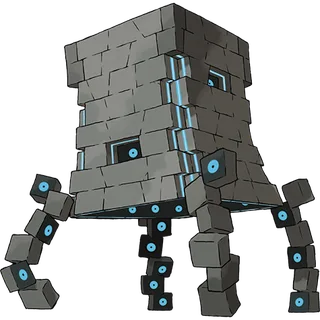
Stakataka


Abilities
The Pokémon boosts its most proficient stat each time it knocks out a Pokémon.
Base Stats
Stakataka's Weaknesses and Resistances





Evolution Chain
Stakataka does not evolve into or from any other Pokémon.
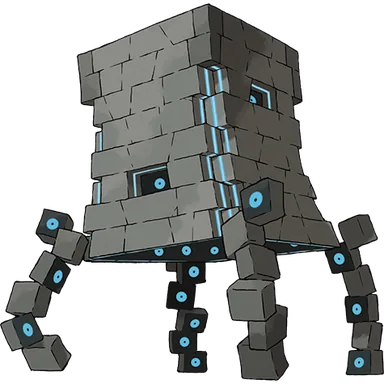 Stakataka
 Playthrough, Competitive, and Nuzlocke Usage
Using Stakataka in a Playthrough
Stakataka is a single-stage Rock/Steel Ultra Beast introduced in Ultra Sun and Ultra Moon and obtained only very late, so it is generally a postgame or optional-content powerhouse rather than a normal island-challenge team member. Its base 211 Defense is among the highest in the series, while 131 Attack and 101 Special Defense give it real offensive and mixed defensive value; the price is base 13 Speed, which is so low that Stakataka virtually always moves last outside Trick Room. That extreme slowness is actually an offensive advantage for Gyro Ball, which can reach maximum power against fast opponents, and Trick Room can reverse turn order so that Stakataka becomes one of the fastest practical attackers for several turns. Rock/Steel grants a Poison immunity, 4× resistances to Normal and Flying, and several other resistances, but it also creates catastrophic 4× weaknesses to Fighting and Ground plus a Water weakness. Stone Edge or Rock Slide provides secondary STAB, Earthquake and Superpower or Body Press offer coverage in appropriate generations, and Beast Boost will normally increase Defense unless the stat spread is deliberately manipulated to make Attack highest. Brave is the natural ordinary Nature because it increases Attack while reducing a Speed stat Stakataka actively wants as low as possible for both Trick Room and Gyro Ball.
Stakataka in Competitive Pokémon
Stakataka carved out one of the most distinctive Trick Room niches of Generation VII thanks to a combination of base 13 Speed, base 131 Attack, and a monstrous base 211 Defense. It was classified RUBL while receiving serious UU use, where its extraordinarily slow Gyro Ball reached enormous power against ordinary targets and Trick Room allowed it to reverse the Speed disadvantage and begin sweeping. A famous optimization used a Lonely Nature and carefully reduced Defense IVs so that Attack became Stakataka's highest actual stat, causing Beast Boost to raise Attack after a knockout rather than making its already excessive Defense even higher. It also had meaningful doubles and VGC use because Trick Room is naturally stronger in doubles, Rock Slide can pressure both opponents, and its low Speed allows it to move extremely early once the room is established. Sword and Shield lowered Stakataka to NU, where it remained an excellent defensive Steel-type and Trick Room breaker; Body Press additionally gave later sets a way to convert the enormous Defense stat directly into Fighting-type damage. Its competitive flaws are impossible to ignore, however: 4× Fighting and Ground weaknesses mean common attacks such as Close Combat and Earthquake can bypass its impressive raw bulk, while bulky Water-types exploit its only ordinary weakness and poor Speed outside Trick Room. Stakataka is unavailable in standard Scarlet and Violet, so Generation VIII NU is its latest conventional usage-tier placement.
Stakataka in Nuzlockes
Stakataka can make physical neutral attacks look trivial in a Nuzlocke because base 211 Defense is extraordinary, but its typing creates two matchup failures so severe that raw Defense cannot be treated as universal safety. Ground and Fighting attacks deal 4× damage, meaning moves such as Earthquake, High Horsepower, Close Combat, and even weaker coverage can be fatal despite Stakataka's enormous defensive stat. Against Normal-, Flying-, Rock-, Psychic-, Ice-, Dragon-, Fairy-, or Bug-type physical moves it can be exceptionally reliable, and the Poison immunity prevents one common form of attrition. Gyro Ball is accurate and becomes extremely powerful precisely because Stakataka is so slow, while Trick Room can let it attack first without requiring a risky Speed-boosting setup strategy. Stone Edge's imperfect accuracy is less attractive in survival-critical situations than Rock Slide or another accurate option when the lower power still secures the knockout. Body Press in later games is an unusually safe offensive tool because it exploits the same massive Defense that keeps Stakataka alive, but the player should still switch immediately rather than attempting to tank a known 4×-effective Ground or Fighting attack.
Learnsets
16 moves · Sword Shield
Level Up — Sword Shield



Pokédex Entries
2 entries
It appeared from an Ultra Wormhole. Each one appears to be made up of many life-forms stacked one on top of each other.
When stone walls started moving and attacking, the brute’s true identity was this mysterious life-form, which brings to mind an Ultra Beast.
Where To Find Stakataka
1 locations
Poni Grove · AlolaOne-time, Walking · version details vary
Poni Grove Area
Additional Images
PokeAPI sprites
Open this section to load extra PokeAPI sprite images.
Stakataka Biology and Behavior
Stakataka is not one indivisible organism but a colony of many brick-like stone life-forms assembled into the shape of a four-sided tower. Phyco describes one Stakataka as containing almost 150 individual components, while the visible model can be counted as 137 separate stones, each with its own glowing eye on the underside. The eyes normally glow blue but turn red when the colony is angry or engaged in battle. Stakataka can rearrange its component organisms, forming legs, opening sections of the tower to allow attacks to pass through, or enclosing an opponent inside the structure. When sleeping it plants itself against the ground and disguises the entire colony as an ordinary stone building. It strongly dislikes having objects placed on top of it and may thrash violently to remove them, but animated canon shows that an individual capable of enduring the shaking and successfully riding Stakataka can earn the colony's respect.
Stakataka Biological Data
- National Pokédex
- #805
- Species
- Rampart Pokémon
- Height
- 18' 1" (5.5 m)
- Weight
- 1807.8 lbs (820.0 kg)
- Habitat
- Currently Unknown
- Color
- Gray
- Body Style
- Quadruped
- Gender
- Genderless
Misc
Catch Rate: 30
Base Experience: 257 Exp
Hatch Counter: 120
Stakataka Size Comparison: BETA
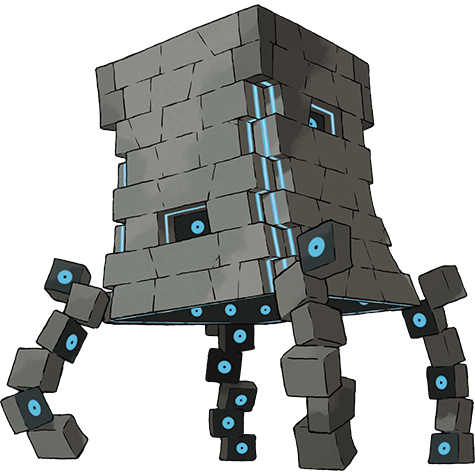
Stakataka is listed at 18' 1" (5.5 m) and shown in an in-chart visual comparison.

How is visual size determined?
Pokédex height is treated as the official listed measurement, but the chart uses pose-aware visual scaling so each sprite looks reasonable in a direct comparison.
For long or coiled Pokémon, the listed height may represent total body length rather than upright height. For Pokémon with floppy ears, leaves, feathers, antennae, wings, or other flexible features, the chart usually measures to the top of the solid, substantial part of the head or body instead of the tallest decorative feature.
The goal is not to replace the official height, but to make the artwork compare naturally at the size it appears to occupy.