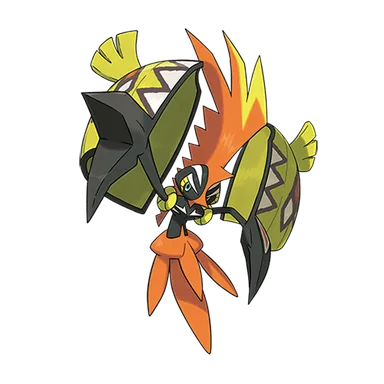
Tapu Bulu is a Grass/Fairy-type Pokémon introduced in Generation VII, with a base stat total of 570 and no standard evolutions.
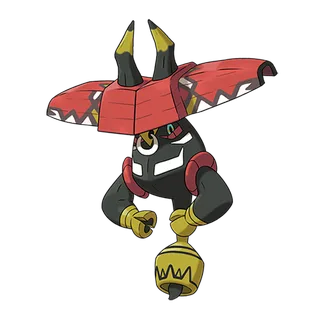
Tapu Bulu


Abilities
Turns the ground into Grassy Terrain when the Pokémon enters a battle.
Anticipates an ally’s attack and dodges it.
Hidden AbilityBase Stats
Tapu Bulu's Weaknesses and Resistances







Evolution Chain
Tapu Bulu does not evolve into or from any other Pokémon.
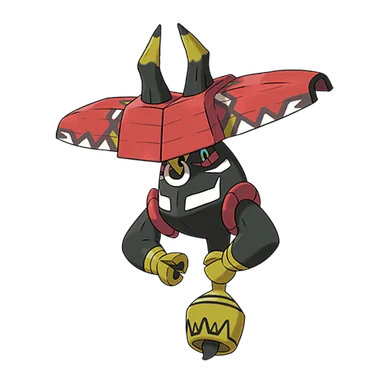 Tapu Bulu
 Playthrough, Competitive, and Nuzlocke Usage
Using Tapu Bulu in a Playthrough
Tapu Bulu is a single-stage Grass/Fairy Legendary that is normally obtained only after the Alola League, so its excellent battle statistics are generally reserved for postgame use in its debut games rather than the initial story. Base 130 Attack, 115 Defense, and 95 Special Defense make it a powerful physical tank and wallbreaker, while Grassy Surge automatically creates Grassy Terrain to strengthen grounded Grass-type attacks, restore grounded Pokémon's HP each turn, and halve the power of Earthquake, Bulldoze, and Magnitude. Horn Leech is particularly valuable because terrain boosts its damage while the move heals Tapu Bulu, creating unusually efficient offense and recovery; Wood Hammer offers far greater damage at the cost of recoil, while Superpower, Stone Edge, and other coverage handle resistant targets. Grass/Fairy provides a Dragon immunity and six useful resistances, but it also carries weaknesses to Fire, Flying, Ice, and Steel and a dangerous 4× Poison weakness. Generation VIII reduced Grassy Terrain's Grass-type damage boost from 50% to 30%, and Tapu Bulu did not receive Grassy Glide, meaning later competition from Rillaboom is mechanically important rather than merely a matter of popularity. Adamant maximizes its already enormous physical power, while Careful or Impish can be justified on slower defensive builds that emphasize Grassy Terrain recovery, Horn Leech, and its natural bulk.
Tapu Bulu in Competitive Pokémon
Tapu Bulu was an OU Pokémon in Generation VII, where Grassy Surge, base 130 Attack, strong bulk, and recovery from both Horn Leech and terrain let it operate as either a devastating wallbreaker or a surprisingly persistent defensive check. Grassy Terrain did much more than empower Wood Hammer and Horn Leech: it restored grounded teammates every turn and weakened Earthquake, allowing Tapu Bulu to support Steel-types and other partners that normally feared Ground coverage. Swords Dance, Choice Band, specially defensive, and mixed utility sets all saw use, with Superpower and Stone Edge punishing several common Grass resists that otherwise appeared safe. Its Generation VIII standing declined to UU because Grassy Terrain's offensive boost was reduced to 1.3×, Z-Moves disappeared, and Rillaboom became an alternative Grassy Surge user with higher Speed and access to priority Grassy Glide, a move Tapu Bulu notably did not receive. Tapu Bulu nevertheless remained a strong UU wallbreaker and defensive Grass-type, with excellent bulk, Horn Leech, Synthesis, and terrain support preserving legitimate value despite that competition. Its long-term weaknesses are middling base 75 Speed, a 4× Poison weakness, and susceptibility to common Steel- and Flying-types, which make it more matchup-dependent than Koko, Lele, or Fini at their competitive peaks.
Tapu Bulu in Nuzlockes
Tapu Bulu can be extremely safe against the right opponents because Grassy Terrain provides passive recovery every turn while also weakening Earthquake, one of the most common high-power physical moves in the series. Its Dragon immunity and resistances to Dark, Electric, Fighting, Grass, Ground, and Water create many useful switch opportunities, and base 115 Defense plus 95 Special Defense give it substantial margin against neutral attacks. Horn Leech is one of its best Nuzlocke attacks because it is accurate, receives terrain and STAB bonuses, and restores HP without requiring a separate recovery turn. Wood Hammer is much less attractive in permadeath play because recoil can erase the health advantage gained from Grassy Terrain, while Superpower's stat drops and Stone Edge's imperfect accuracy introduce additional risk. The critical warning is the 4× Poison weakness: even a Pokémon that Tapu Bulu otherwise walls can become lethal if it carries Sludge Bomb, Poison Jab, or another strong Poison move. Because base 75 Speed is only moderate, the safest approach is to exploit known resistances and healing rather than assuming Tapu Bulu can simply attack before every threatening coverage move.
Learnsets
17 moves · Sword Shield
Level Up — Sword Shield






Pokédex Entries
4 entries
It pulls large trees up by the roots and swings them around. It causes vegetation to grow, and then it absorbs energy from the growth.
The guardian deity of Ula’ula is a lazy Pokémon. It commands plants to immobilize its foes and then deals them a savage blow with its horns.
Although it’s called a guardian deity, it’s violent enough to crush anyone it sees as an enemy.
It makes ringing sounds with its tail to let others know where it is, avoiding unneeded conflicts. This guardian deity of Ula’ula controls plants.
Where To Find Tapu Bulu
1 locations
Ruins of Abundance · AlolaOne-time · version details vary
Ruins Of Abundance Area
Additional Images
PokeAPI sprites
Open this section to load extra PokeAPI sprite images.
Tapu Bulu Biology and Behavior
Tapu Bulu is the guardian deity of Ula'ula Island and resides at the Ruins of Abundance, with the ability to make vegetation grow and reshape it at will. It can pull entire trees from the ground and wield them as clubs, then absorb energy from the vegetation it has caused to flourish. Despite this enormous physical power, Tapu Bulu is generally inactive and avoids unnecessary conflict, ringing the bell-like structure on its tail to warn others of its presence so that fights do not begin accidentally. Its restraint has clear limits: it is merciless toward those it judges to be enemies, and Alolan tradition associates ruined settlements and defeated thieves with its wrath. The shell closes into the form of a stylized bull, and like the other guardian deities Tapu Bulu protects its island against Ultra Beasts and participates in safeguarding Cosmog.
Tapu Bulu Biological Data
- National Pokédex
- #787
- Species
- Land Spirit Pokémon
- Height
- 6' 3" (1.9 m)
- Weight
- 100.3 lbs (45.5 kg)
- Habitat
- Currently Unknown
- Color
- Red
- Body Style
- Arms
- Gender
- Genderless
Misc
Catch Rate: 3
Base Experience: 257 Exp
Hatch Counter: 15
Tapu Bulu Size Comparison: BETA
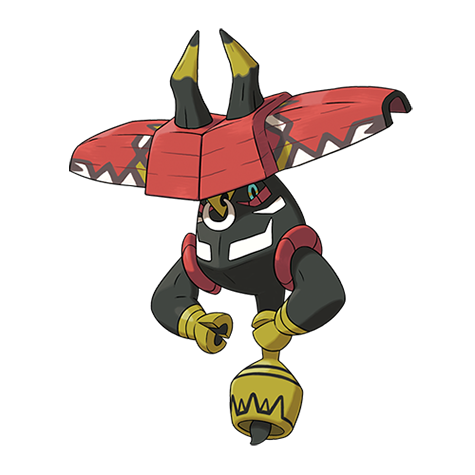
Tapu Bulu is listed at 6' 3" (1.9 m) and shown in an in-chart visual comparison.

How is visual size determined?
Pokédex height is treated as the official listed measurement, but the chart uses pose-aware visual scaling so each sprite looks reasonable in a direct comparison.
For long or coiled Pokémon, the listed height may represent total body length rather than upright height. For Pokémon with floppy ears, leaves, feathers, antennae, wings, or other flexible features, the chart usually measures to the top of the solid, substantial part of the head or body instead of the tallest decorative feature.
The goal is not to replace the official height, but to make the artwork compare naturally at the size it appears to occupy.