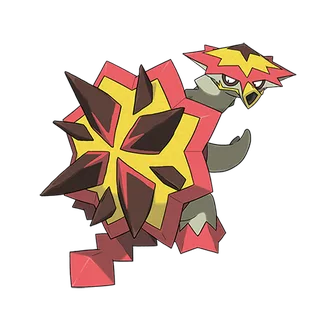
Turtonator is a Fire/Dragon-type Pokémon introduced in Generation VII, with a base stat total of 485 and no standard evolutions.
Turtonator


Abilities
Blocks critical hits.
Base Stats
Turtonator's Weaknesses and Resistances





Evolution Chain
Turtonator does not evolve into or from any other Pokémon.
 Turtonator
 Playthrough, Competitive, and Nuzlocke Usage
Using Turtonator in a Playthrough
Turtonator is a single-stage Fire/Dragon Pokémon with excellent base 135 Defense and useful base 91 Special Attack, but only 60 HP and 36 Speed, making it much better at absorbing physical hits than moving before opponents. Its typing is defensively valuable, strongly resisting Fire and Grass and also resisting Bug, Electric, and Steel while leaving only Dragon, Ground, and Rock weaknesses; however, the Rock weakness also makes entry hazards more troublesome in formats or playthroughs where Stealth Rock is common. Shell Armor is outstanding for consistency because Turtonator cannot be struck by critical hits, giving defensive calculations much more reliability than most Pokémon enjoy. Shell Smash can transform its poor Speed and moderate Special Attack into sweeping power by raising both offenses and Speed two stages, while Dragon Pulse and reliable Fire moves are safer ordinary STAB options than relying constantly on Draco Meteor or Fire Blast. Its signature Shell Trap reaches enormous power if Turtonator is struck by a physical attack after setting the trap, but it fails if the opponent does not trigger it, making it more situational in a normal playthrough than its 150 base power suggests. Turtonator is also version-restricted in its main appearances—wild in Sun/Ultra Sun and Sword but not their paired versions—so availability can determine whether it is practical at all; Timid is useful on Shell Smash sets, while Modest is reasonable when prioritizing damage over post-boost Speed.
Turtonator in Competitive Pokémon
Turtonator has been a specialized lower-tier Shell Smash sweeper rather than a broadly dominant Fire- or Dragon-type. In Generation VII it was classified ZUBL but received PU analysis, where Fire/Dragon STAB was exceptionally difficult for the tier to resist and base 135 Defense gave it setup opportunities against weaker physical attackers. Shell Smash was essential because base 36 Speed is otherwise crippling, and Z-Moves could turn Draco Meteor into a one-time Dragon attack capable of breaking defensive checks without suffering the usual Special Attack drop on the Z-Move itself. Even after a Shell Smash, however, common Choice Scarf users could revenge kill it, while Stealth Rock, the defensive drops from Shell Smash, and competition from Fire- or Dragon-types with stronger immediate pressure limited its consistency. Sword and Shield preserved essentially the same role: Turtonator remained ZUBL with PU usage as a niche hyper-offense sweeper, using Shell Smash, Fire Blast, Dragon STAB, and coverage such as Flash Cannon. It is unavailable in standard Scarlet/Violet, so its competitive history remains centered on Generations VII and VIII and has not developed a normal Generation IX usage-tier chapter.
Turtonator in Nuzlockes
Turtonator has one of the best variance-control Abilities available for a Nuzlocke because Shell Armor completely prevents critical hits, allowing its enormous physical Defense to function without the usual fear that one unlucky crit will bypass accumulated defensive advantages. Fire/Dragon also provides several useful resistances and only three weaknesses, making Turtonator a strong physical switch-in when the opponent's Ground-, Rock-, and Dragon-type coverage has been ruled out. The danger is low Speed and only average Special Defense, so a strong special attacker can damage Turtonator heavily before it acts even when the matchup looks favorable on typing alone. Shell Smash is powerful but explicitly lowers Defense and Special Defense, sacrificing part of the reliability that makes Shell Armor so attractive; in permadeath play it is best reserved for an opponent that cannot punish the setup turn. Shell Trap is even more prediction-dependent because it requires Turtonator to prepare the move and then be struck physically, so it should not be treated as guaranteed 150-power damage when a straightforward Fire or Dragon attack would safely secure the knockout. Accurate Dragon Pulse or Flamethrower-style options are usually preferable to unnecessary reliance on Draco Meteor or Fire Blast when the extra power is not required.
Learnsets
15 moves · Sword Shield
Level Up — Sword Shield





Pokédex Entries
6 entries
The shell on its back is chemically unstable and explodes violently if struck. The hole in its stomach is its weak point.
It gushes fire and poisonous gases from its nostrils. Its dung is an explosive substance and can be put to various uses.
It lives in volcanoes and eats sulfur and other minerals. Materials from the food it eats form the basis of its explosive shell.
Its exploding shell poses a real danger but is sensitive to moisture. On rainy days, Turtonator takes silent refuge in caves.
Explosive substances coat the shell on its back. Enemies that dare attack it will be blown away by an immense detonation.
Eating sulfur in its volcanic habitat is what causes explosive compounds to develop in its shell. Its droppings are also dangerously explosive.
Where To Find Turtonator
1 locations
Blush Mountain · AlolaWalking · version details vary
Blush Mountain Area
Held Items
1 items
- Sun: 5% chance
- Moon: 5% chance
- Ultra Sun: 5% chance
- Ultra Moon: 5% chance
Additional Images
PokeAPI sprites
Open this section to load extra PokeAPI sprite images.
Turtonator Biology and Behavior
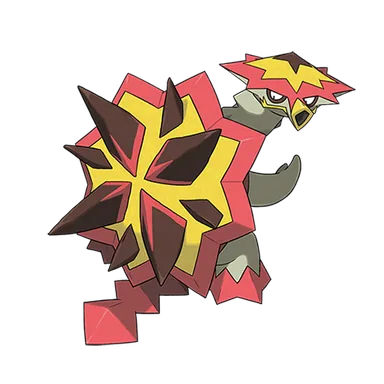
Turtonator lives in volcanic environments, where its rocky appearance lets it camouflage itself while waiting for prey and where it consumes sulfur and other minerals as part of its normal diet. Compounds derived from that mineral-rich food accumulate in its shell as unstable explosive material, and even its feces become dangerously explosive enough to have practical uses. When prey steps on the shell, Turtonator can strike itself with its own tail, creating sparks at the shell spikes and detonating the explosive coating outward through the opening on its chest. That chest opening is also its anatomical weak point, so the shell combines an extremely dangerous defensive weapon with a specific vulnerable region. Moisture interferes with the shell's explosive properties; on rainy days Turtonator retreats quietly into caves rather than remaining exposed on the volcano. It can additionally expel flame and poisonous gases through its nostrils, making its volcanic diet responsible for several different offensive adaptations rather than only its signature shell explosions.
Turtonator Biological Data
- National Pokédex
- #776
- Species
- Blast Turtle Pokémon
- Height
- 6' 7" (2.0 m)
- Weight
- 467.4 lbs (212.0 kg)
- Habitat
- Currently Unknown
- Color
- Red
- Body Style
- Upright
- Gender
- 50% female / 50% male
Misc
Catch Rate: 70
Base Experience: 170 Exp
Hatch Counter: 20
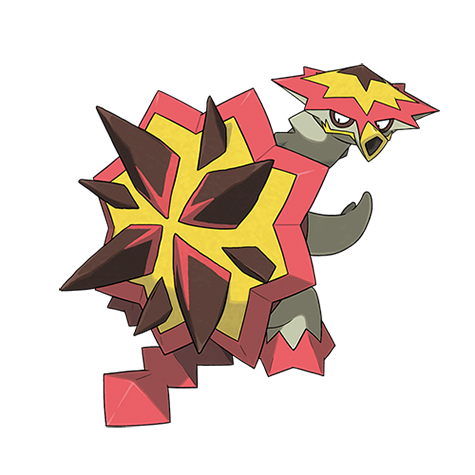
Turtonator Size Comparison: BETA
Turtonator is listed at 6' 7" (2.0 m); this chart uses a pose-adjusted visual scale.

How is visual size determined?
Pokédex height is treated as the official listed measurement, but the chart uses pose-aware visual scaling so each sprite looks reasonable in a direct comparison.
For long or coiled Pokémon, the listed height may represent total body length rather than upright height. For Pokémon with floppy ears, leaves, feathers, antennae, wings, or other flexible features, the chart usually measures to the top of the solid, substantial part of the head or body instead of the tallest decorative feature.
The goal is not to replace the official height, but to make the artwork compare naturally at the size it appears to occupy.
Turtonator currently uses a pose-adjusted visual scale.